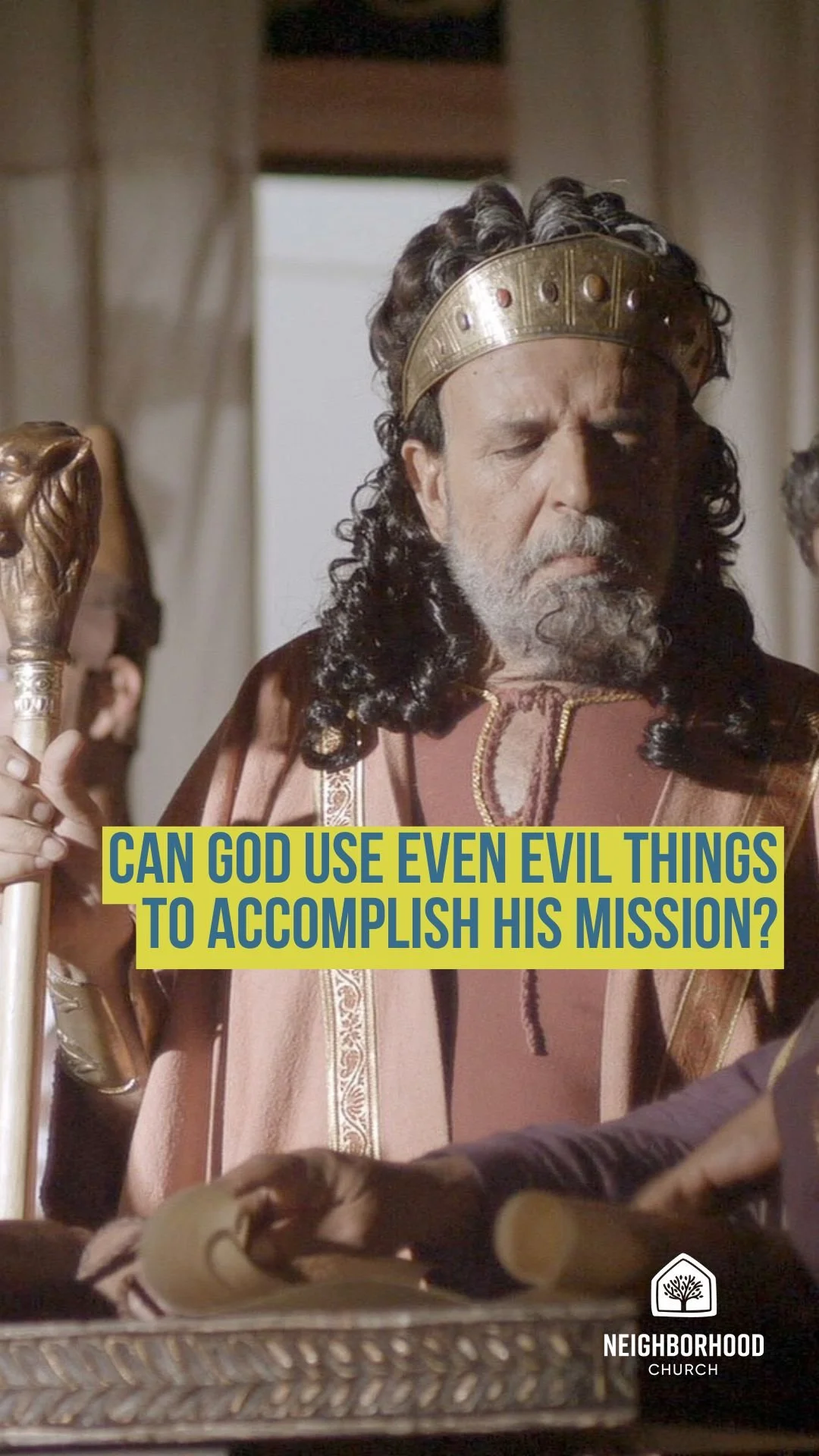

Can God use even evil things to accomplish his mission?
We tend to skip over certain parts of the Christmas story. We love the angels and the shepherds and the wise men bringing gifts. But there's a chapter we rarely talk about—one that involves a paranoid king, a narrow escape, and an unspeakable tragedy.
It's not the version you'll find on greeting cards. But it's part of the story, and it reveals something crucial: God's impossible mission even outwits what is meant for evil.
The king who wasn't happy about a new king
After Jesus was born in Bethlehem, wise men from the east arrived in Jerusalem asking, "Where is he who has been born king of the Jews? For we saw his star when it rose and have come to worship him" (Matthew 2:1-2).
This question landed at the feet of Herod the Great—the Roman-appointed ruler of Judea. And when Herod heard about it, he was troubled, "and all Jerusalem with him" (Matthew 2:3). The whole city noticed that Herod was upset, and that made them nervous. Because when Herod got upset, things got dangerous.
Here's what you need to know about Herod: He was called "the Great" not because he was wonderful, but because he thought he was wonderful. He was a master builder who constructed some of the most impressive structures in the ancient world. He was also deeply paranoid.
Herod's family had been forced to convert to Judaism to survive, so he didn't grow up with Jewish values. But he used religion as a political tool—acting religious enough to convince people he was legitimate so they'd accept his rule. It's troubling to imagine politicians manipulating religion for power, but this is ancient history, so we'll give them some grace there.
His paranoia wrecked his personal life. Historical records show he was deeply in love with his wife, but when she repeated comments about his mother that suggested he wasn't truly authorized to rule, he had her executed. She was the first family member he killed, but not the last. Whenever one of his sons showed leadership ability, Herod would have him killed too—couldn't have anyone competing for the throne.
On his deathbed, Herod even made a decree that when he died the police should kill someone from every family in his region so that at his funeral, everyone would be legitimately upset. (The law wasn't carried out, but the fact that he made it tells you everything you need to know about this guy.)
So when wise men show up asking about a newborn "king of the Jews," Herod has questions.
The search for the child
Herod gathered the chief priests and scribes and asked where the Christ—the Messiah, the chosen one—was supposed to be born. They told him: Bethlehem, according to the prophet Micah (Matthew 2:4-6).
Then Herod did something revealing. He summoned the wise men secretly and asked when the star had appeared. He didn't want anyone knowing he was commissioning a search for another king. Then he sent them to Bethlehem with instructions: "Go and search diligently for the child, and when you have found him, bring me word, that I too may come and worship him" (Matthew 2:7-8).
That sounds sweet, doesn't it? "That I too may come and worship him."
But Herod's version of worship wasn't going to involve gifts and bowing. His worship would have been to kill God as a sacrifice to make himself king.
What is our instinct when we hear that God has sent a new Lord and King? Do we truly want to worship him, or do we want to destroy him to keep control of our own lives?
The gifts that saved a family
The wise men followed the star until "it came to rest over the place where the child was" (Matthew 2:9). Notice that detail—not just to Bethlehem, but to a specific house. Something supernatural was guiding them with precision.
When they found Jesus, they "fell down and worshiped him. Then, opening their treasures, they offered him gifts, gold and frankincense and myrrh" (Matthew 2:11).
These aren't typical baby gifts. You don't normally give infants precious metals and spices. But each gift carried meaning:
Gold was worthy of a king—a symbol of Jesus' royalty and perhaps his divinity (since temple furniture was covered in gold)
Frankincense was burned as incense in worship, representing prayers rising to God
Myrrh was used for embalming the dead, or mixed with wine as a sedative for extreme pain—the kind they offered Jesus at his crucifixion
If Jesus' birthplace revealed his priorities (coming to humble circumstances), what do these gifts indicate? Was the story of his life told before he even lived it?
But beyond their symbolic meaning, these gifts had a practical purpose: they provided the money the holy family needed to escape.
After the wise men left, "an angel of the Lord appeared to Joseph in a dream and said, 'Rise, take the child and his mother, and flee to Egypt, and remain there until I tell you, for Herod is about to search for the child, to destroy him'" (Matthew 2:13).
This was Joseph's second dream-warning from God. And this time, he needed resources to act on it. Mary and Joseph weren't wealthy. They didn't own property they could sell. They were staying with family. But the wise men had just delivered gold—enough to finance relocating to a different country.
God is providing in the direction he's guiding. He won't call you in a way that he's not going to be with you on the journey.
But here's the temptation: when God begins to provide, we choose to stay where we're at and heap up the treasure. We get a little extra in the budget and think, "Sweet, I can buy that upgrade I've been wanting." Especially at Christmas—we've got to buy extra gifts, right?
So the question becomes: What are we hoarding that God gave to be used for his purpose?
The tragedy we don't talk about
The wise men, warned in a dream not to return to Herod, went home by another route (Matthew 2:12). Meanwhile, Joseph took Mary and Jesus to Egypt.
Then Herod realized he'd been tricked.
"When Herod saw that he had been tricked by the wise men, he became furious, and he sent and killed all the male children in Bethlehem and in all that region who were two years old or under" (Matthew 2:16).
We don't usually include these verses in Christmas pageants. But in case you thought the danger to Jesus was exaggerated—no, it was legitimate. Herod didn't want to worship. He wanted to murder. And when he couldn't figure out which child was the King of the Jews, he killed them all.
This is the same guy who, on his deathbed, ordered executions at his funeral. This level of sadism is historically documented.
God's impossible mission even outwits what is meant for evil. Herod thought he could destroy God's plan. But God had already moved Jesus out of reach.
Still, we can't gloss over the reality: there were families in Bethlehem who lost their children. There were people who watched Jesus grow up and were bitter because their children did not.
This is the cost of living in a world where evil exists. And it's a reminder that God's mission doesn't mean suffering disappears—it means God works through and beyond the suffering to accomplish something evil cannot stop.
Coming home to a city of low reputation
When Herod died, an angel appeared to Joseph again: "Rise, take the child and his mother and go to the land of Israel, for those who sought the child's life are dead" (Matthew 2:19-20).
So Joseph took his family back to Israel. But when he heard that Herod's son Archelaus was now ruling Judea, "he was afraid to go there" (Matthew 2:22). Archelaus had a reputation for being just as cruel as his father and Rome pretty quickly replaced him.
Notice what Joseph does with his fear: he doesn't run away from God or get angry at God for bringing him back into danger. He uses his fear to drive him to seek God. And God answers—his fourth dream in this story—directing him to settle in Galilee, in the city of Nazareth.
This matters because Nazareth wasn't a great place. There's a line later in Scripture that reflects the attitude toward this city: "Can anything good come out of Nazareth?" (John 1:46). It was a backwater town, full of blue-collar workers just scraping to get by. Low reputation. Low expectations.
And Jesus—who could have chosen to be born to any family at any time in any place—chose to grow up there.
What does that say about the heart of God?
It says God meets us in places of low reputation. In places nobody else would desire to be. In circumstances that don't sparkle or impress.
What this means for us
Following God doesn't mean we stop using wisdom. Joseph received direction from God, but he also paid attention to the situation around him and sought God's guidance in the details.
Following God doesn't mean we ignore our fears. Joseph was afraid—but he let that fear push him toward God rather than away from God.
And following God doesn't mean everything will be comfortable or prestigious. After all the danger, all the travel, all the upheaval—the family ended up back where they started, in an unremarkable town.
Ever feel like you've been working really hard and you just end up back where you started?
Maybe that's exactly where God wants to meet you.
So whatever you're feeling this season—if you've had to tighten the belt and things aren't as sparkly as they used to be, if you're missing people and it doesn't feel right, if you're in a place of low reputation or circumstances nobody would envy—know this:
God meets us in those places. His presence is the prize. If he's in Nazareth, that's where we want to be.
God's impossible mission outwits even what's meant for evil. Herod tried to stop it. The world tried to ignore it. Circumstances seemed stacked against it.
But God provided exactly what was needed, exactly when it was needed. He guided his people with wisdom and dreams. He protected the child who would grow up to be the Savior.
And he invites us to trust that same guidance today—to use what he's given us for his purposes, to let our fears drive us to him rather than away from him, and to embrace whatever place he calls us to, even if it's a place of low reputation.
Because wherever God is, that's the place worth being.