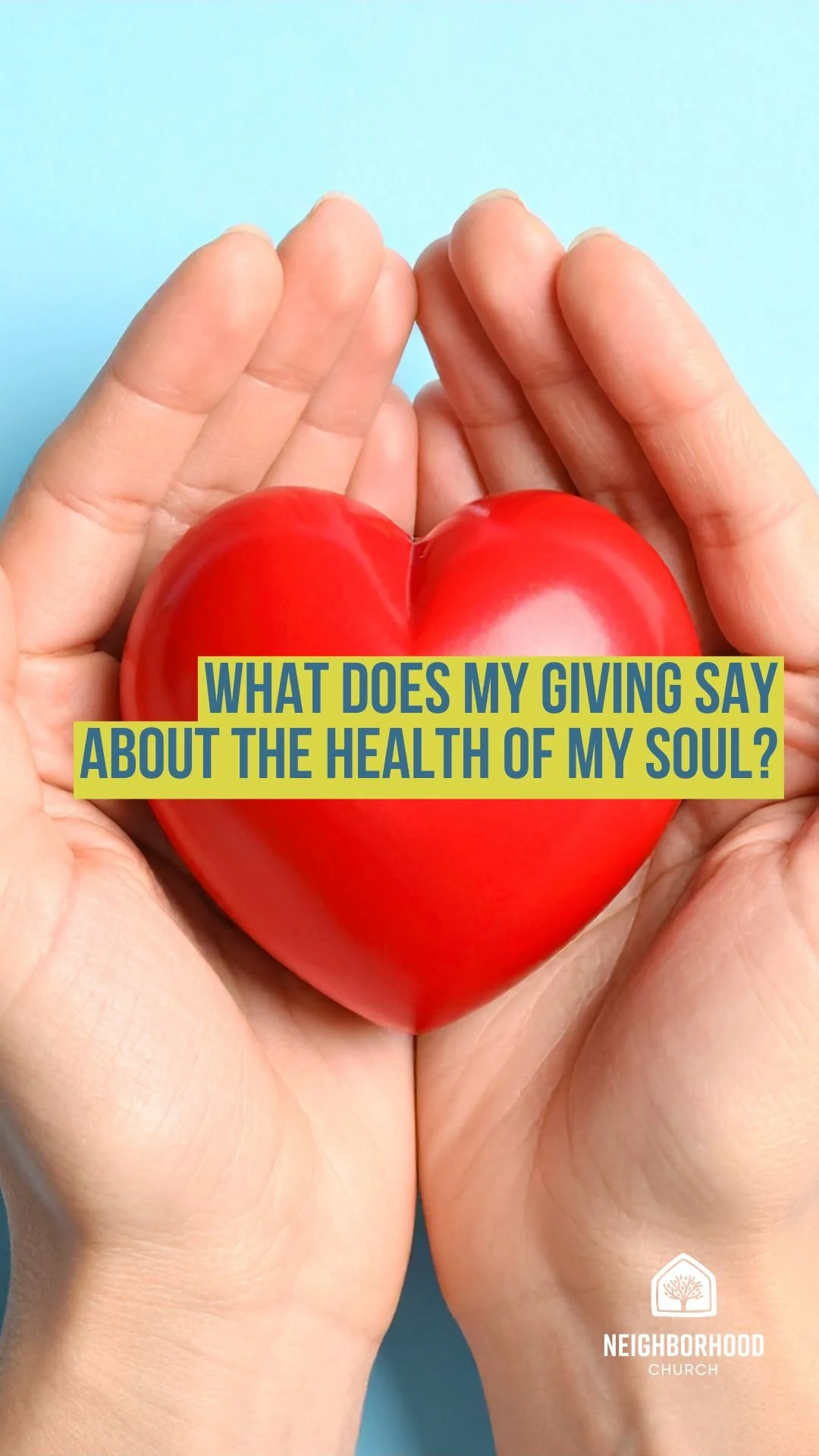

What does my giving say about the health of my soul?
Picture a king. Not just any king, but one who's been on the throne for decades—and everybody still likes him. That's hard to imagine, isn't it? The longer someone's in office, the harder it seems to be for us to deal with them, whether we liked them at the start or not.
But that's exactly who King David was. At the end of his reign in ancient Israel, he was still well-loved, still respected. And now he had to pass the baton to his son Solomon.
Before we dive into what happened next, let's do something a little silly: put your hands out in front of you. Now clench your fists tight.
This is what we naturally do with God's gifts. "This is MINE. No one can touch it."
Now open your hands.
God calls us to hold His gifts with open hands. When we come to God with open hands, He can fill them with whatever He wants. When we clench our fists, we strangle what He's given us.
This is one of our core values at Neighborhood Church: We hold God's gifts with open hands—both receiving from God what He's given us and letting Him direct how we share those gifts with others.
And in 1 Chronicles 29, we get a powerful picture of what this looks like.
A king's final act
David gathered all his officials, commanders, warriors, and his sons together. He wanted everyone on the same page about what mattered most as leadership transitioned to Solomon.
His big project? Building a palace—not for Solomon, but for God. A temple where God's presence would dwell.
Listen to what David said:
"I have provided for the house of my God, so far as I was able" (1 Chronicles 29:2).
Catch that phrase? "So far as I was able."
Here's something important: God doesn't ask us to give what we don't have.
Sometimes we think God wants everything—even things we don't have yet. We put a burden on ourselves to be more generous than God even expects. But David says clearly: I provided as best as I could with what I have.
If you're in a season where you don't have much, let that be a comfort. God doesn't ask for things we don't have.
But here's the flip side: If God is asking you to give something, you probably have it to give. We just might not want to admit it.
Beyond the job description
Now, David was king of Israel—a nation God Himself started. Part of David's job was leading this temple project. That was his responsibility.
But then David does something extra:
"Moreover, in addition to all that I have provided for the holy house, I have a treasure of my own of gold and silver, and because of my devotion to the house of my God I give it" (1 Chronicles 29:3).
David didn't just do his job. He also gave from his personal resources because he cared so much about what God was doing.
Why? Because God's generosity toward us spurs our devotion to His work.
David wasn’t just a nice guy, there’s a bigger story here. God had been incredibly generous to David:
God made him king despite being the youngest, smallest, shepherd boy (1 Chronicles 17)
God gave him opportunities to work for Him, even after David's failures (1 Chronicles 21)
God gave him a favorable reputation with the people (1 Samuel 18)
God gave him the strength to accomplish his goals (2 Samuel 22)
God gives us the desire to honor Him. He gives us opportunities to work for Him. He gives us the strength to accomplish goals. And then He invites us to respond.
An invitation, not a demand
After explaining what he'd done, David asked this question:
"Who then will offer willingly, consecrating himself today to the LORD?" (1 Chronicles 29:5).
Here's something fascinating about that word "consecrating." It's the same word used for ordination—when priests were set apart for God's service. And the literal meaning? "Filling your hands."
Think about that. Priests didn't offer anything they weren't already given. The sign that they were set apart for God was what was placed IN their hands, not what they took from their own resources.
Our hands are filled by willingly dedicating ourselves to God.
It sounds backwards, doesn't it? We think giving means emptying our hands. But what if opening our hands to give actually positions us to receive more from God?
The joy of willing participation
So what happened when the people responded?
"Then the people rejoiced because they had given willingly, for with a whole heart they had offered freely to the LORD. David the king also rejoiced greatly" (1 Chronicles 29:9).
There it is: There's a profound joy in willingly sharing in God's costly work.
Notice the order. They didn't rejoice first and then give. They gave willingly, and THEN they rejoiced.
We usually ask, "What's this going to cost me?" We assume participation in something costly will diminish our quality of life. But when we willingly offer ourselves to God's work, He brings us profound joy.
It seems pretty clear that we live in the most prosperous country in the history of the world. Warm showers? Most of humanity has only dreamed of that luxury. Coffee? Once the exclusive drink of royalty. Here we give it away for free to everyone.
We are the most prosperous people who've ever lived. And yet we are mentally fragile, emotionally exhausted, longing for fulfillment, isolated from one another.
What if, by clenching our fists around God's gifts and using them only for ourselves, we've robbed ourselves of the joy God gives when we share willingly in His work?
What does your sharing reveal?
Look at what the text says again:
"The people rejoiced because they had given willingly, for with a WHOLE HEART they had offered freely to the LORD" (1 Chronicles 29:9).
How we receive and share gifts from God shows how whole our heart is.
It's not about your money. Really. But your money (and your time, and your abilities) tells something about where your heart is.
Some days we feel fractured, broken, full of static with no clarity. And in those moments, when God approaches us with opportunities to share, we say, "I can't share because I'm not clear."
But what if the clarity comes AFTER the giving? They didn't rejoice at the opportunity to give more. They rejoiced AFTER they had given willingly.
Remembering who God is
David then prays, and his prayer reveals something crucial:
"Blessed are you, O LORD, the God of Israel, our Father, forever and ever. Yours, O LORD, is the greatness and the power and the glory and the victory and the majesty, for all that is in the heavens and in the earth is yours" (1 Chronicles 29:10-11).
God made everything. Not just some things. Everything.
And usually, the things you make are things you own.
He made time. He made your abilities. He gave you your reputation. He provides your strength. Every resource we have, He owned first.
When we give back to God, we're giving Him what already belongs to Him.
That's what stewardship is: taking someone else's resources and using them for the purpose they were given. A good steward uses resources for the owner's purposes. A bad steward takes them and uses them however they want.
A generous heart remembers who God is and thanks Him.
Generosity doesn't start with convincing yourself you have enough. Generosity starts with remembering who God is, thanking Him for who He is and what He's done.
A necessary caution
But here's where we need to pause. What stirs in our hearts when we think about God?
For some of us, there's anger, frustration, anxiety, or unhealthy fear. And sometimes that might be appropriate—if we're far from God, if we're rejecting Him, if we're being bad stewards with what He's given us.
God Himself warns the people of Israel generations after David in Isaiah 1:15: "When you spread out your hands, I will hide my eyes from you; even though you make many prayers, I will not listen; your hands are full of blood."
Wait—I thought if we just hold God's gifts with open hands, He'll keep filling them with blessings?
God doesn't care about your stuff. He's always, ALWAYS after what's happening in your heart.
If you're generous toward God with everything you own but keep your heart to yourself, you're missing the point entirely.
But here's the hope in the very next verse: "Come now, let us reason together, says the LORD: though your sins are like scarlet, they shall be as white as snow; though they are red like crimson, they shall become like wool" (Isaiah 1:18).
Jesus' blood has washed us clean. If there's anger, anxiety, or fear stirring in your heart when you think about God, turn toward Jesus. He's the one who can fix what's broken in you.
Who is God?
David continues:
"But who am I, and what is my people, that we should be able thus to offer willingly? For all things come from you, and of your own have we given you" (1 Chronicles 29:14).
A generous heart remembers who God is AND remembers who is God.
Left to our own devices, most of us assume we're god—that life is about us, what we want, what we're going to do. But a generous heart remembers who is God (hint: it's not us) and then surrenders to Him.
One writer in Scripture asked: "What do you have that you did not receive? And if you received it, why do you boast as if you did not?" (1 Corinthians 4:7).
Even the strength we have to live, think, breathe, and move this very moment is a gift from God. We're blessed to be able to use it for His work.
The diagnostic question
Here's what it all comes down to:
What does our sharing tell us about the health of our soul?
We all have a soul, but we can't see a dashboard that shows us how it's doing. God says our sharing is important—not because He needs our stuff (He already has it), but because it tells us something about the condition of our heart.
2 Corinthians 9:6-8 puts it this way: "Whoever sows sparingly will also reap sparingly, and whoever sows bountifully will also reap bountifully. Each one must give as he has decided in his heart, not reluctantly or under compulsion, for God loves a cheerful giver."
Notice: God doesn't want reluctant giving or compelled giving. He wants hearts that give cheerfully because they remember who He is and what He's done.
So what now?
Here's what we need to wrestle with:
How are you holding God's gifts? With open hands or clenched fists?
What does your sharing reveal about your soul? Not just money—your time, your abilities, your resources, your heart?
What stirs in your heart when you think about God? Gratitude and wonder? Or anger and fear? If it's the latter, turn to Jesus. He can make you clean.
Do you remember who God is? The generous Creator who made everything, owns everything, and gives you every breath?
Do you remember who is God? (Spoiler: it's not you.)
We're not talking about guilt or obligation. We're talking about the profound joy that comes when we willingly participate in what God is doing. We're talking about hearts made whole through surrender rather than hearts fractured through clenching. We're talking about receiving from God with open hands so He can continue to fill them.
Here's the truth: You can't out-give God. You can't surprise Him with your generosity. Everything you have to offer, He gave you first.
But when you open your hands—when you willingly offer what He's given you back to Him for His purposes—something happens in your soul. Joy comes. Wholeness comes. Clarity comes.
Not because you earned it. But because that's what God does when we stop strangling His gifts and start sharing them. It’s what He promises to do when we surrender our whole heart to Him.
So open your hands. Stop clenching what was never yours to keep. Remember who God is. Remember who is God. And watch what He does with a willing heart.
If you're wrestling with these questions—if you're not sure how to open your hands, or if you're feeling convicted about the health of your soul—we'd love to talk with you. Reach out to us at ocala@weareneighborhood.church.
Your sharing reveals the health of your soul. What is yours revealing?