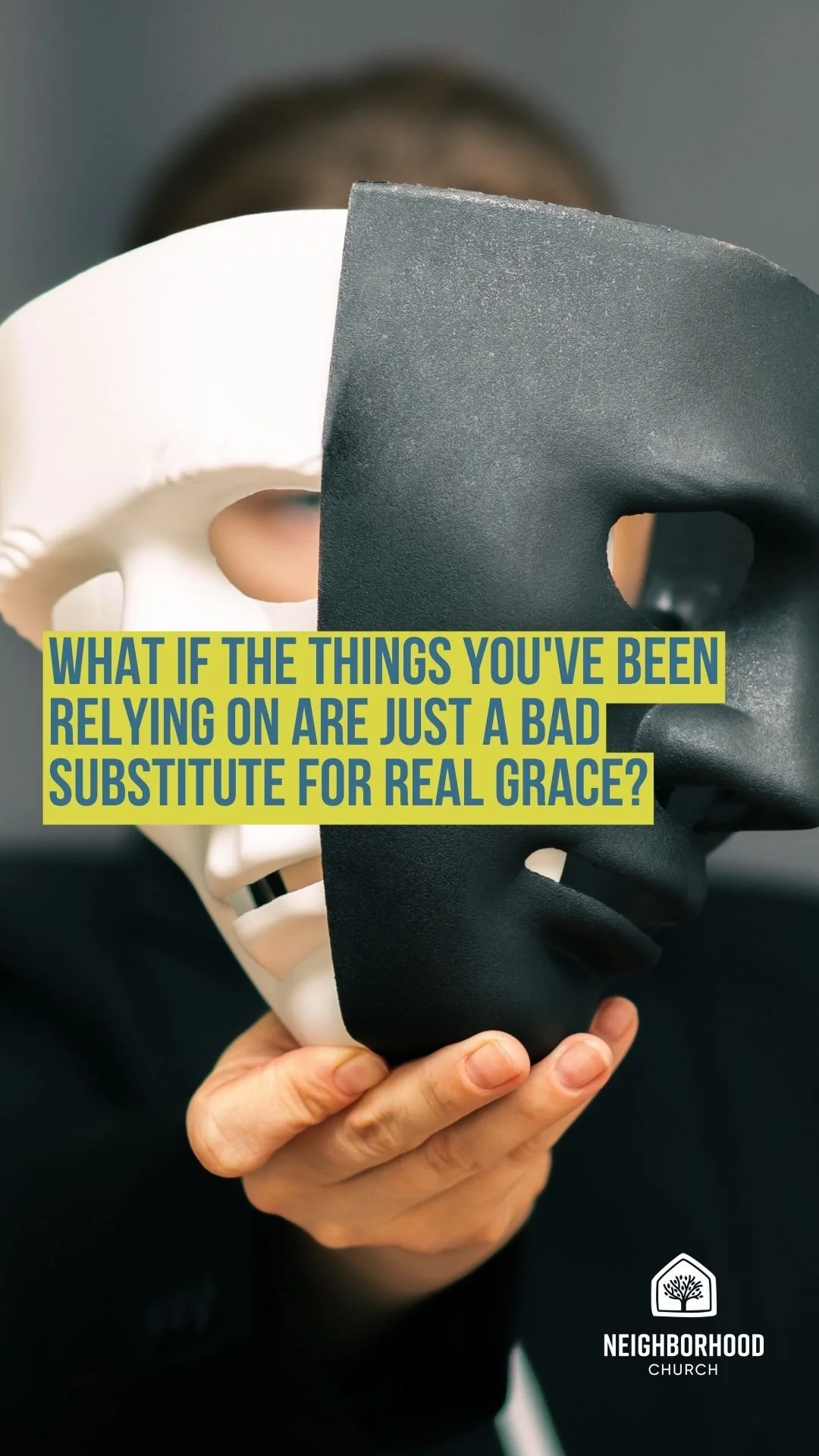

What if the things you've been relying on are just a bad substitute for real grace?
Have you ever gotten used to a bad version of something and not realized it until you tasted the real thing?
Think about that moment when you finally had something genuinely good after years of settling for a knockoff. Not better, not improved, just actually the real thing. And suddenly everything you had before felt a little hollow.
That picture is actually pretty close to what the Apostle Paul is describing in Galatians 2. We are transformed only when we abandon our old substitutes that we used to think were good. And in this week's message, the final one in our Transformed series at Neighborhood Church, we looked at a moment where even one of Jesus' closest friends was caught going back to a bad substitute when things got uncomfortable.
When a leader gets it wrong in public
Paul is writing to a group of churches he started in a region called Galatia. He has spent the first part of his letter making the case that the gospel he preached came directly from Jesus, and that it cannot be added to or improved. Salvation is Jesus, period. Nothing else gets added to it.
Then he tells a story that probably surprised his readers. He describes a moment when he had to confront the Apostle Peter, face to face, in front of everyone (Galatians 2:11).
Here is what happened. Peter had traveled to Antioch, the first church where Jewish and Gentile believers worshiped together. For Jewish people in that culture, eating with non-Jewish people was considered unclean. It was not done. But Peter had already learned through a direct encounter with God that what God calls clean, we should not call unclean (Acts 10). So he sat down and ate with the Gentile believers. No problem.
Then a group of visitors arrived from Jerusalem, people who came from a more traditional Jewish background. And Peter quietly got up and moved tables. He separated himself from the Gentile believers so the visitors would not see him eating with them.
Paul saw it and called it out immediately. He said Peter's behavior was not in step with the truth of the gospel (Galatians 2:14). Even Barnabas, one of the most encouraging and steady people in the early church, got swept along by the same hypocrisy.
We do what we actually believe
Here is the uncomfortable truth underneath Peter's behavior: we do what we actually believe. Not what we say we believe. Not what we know we should believe. What we actually, at the gut level, believe.
Peter knew the truth. He had seen God do remarkable things among the Gentile believers. He had sat at their tables. But when the pressure came, he shifted back to his default setting. The way he grew up. The categories that felt normal and safe.
That is worth sitting with honestly. When things get hard or uncomfortable, where do we go? What are the automatic responses we fall back on? Those patterns reveal what (or who) we actually trust.
Knowing what is right does not mean we do what is right. There are speed limit signs everywhere. Most of us know what they say. That does not mean we follow them. Information is not transformation.
The real problem with adding to the gospel
Paul's deeper point in this passage is not just about social behavior at a dinner table. It is about what Peter's behavior was actually communicating to the Gentile believers. By separating himself, Peter was sending a message: you are not quite fully accepted. There is something more you need to do to belong here and that is exactly the false gospel Paul has been fighting against. The idea that Jesus is the starting point but then there are additional requirements, additional rules, additional things you need to do or avoid in order to earn your standing with God.
Paul is clear: a person is not justified by works of the law, but through faith in Jesus Christ (Galatians 2:16). That word justified means approved. It means God looks at your life and says, you are right with me. And Paul says that approval cannot be earned by doing enough of the right things or avoiding enough of the wrong things. It only comes through trusting Jesus.
“By the works of the law, no one will be justified.” Nobody earns their way to God. Not the most disciplined, rule-following, religiously devoted person you know. The standard is perfection, and none of us are getting there without God’s direct intervention.
Abandoning the old substitutes
Here is where it gets personal. Most of us, before we ever heard about God's grace, had things we trusted as good news. Family loyalty. Career achievement. People's approval. Looking a certain way. Being in control. If I could just manage everything well enough, things would be okay.
Those things are not nothing. Some of them are genuinely good in their proper place. But they become poor substitutes when we lean on them the way we should be leaning on God. And when things get hard, we tend to reach back for them automatically. They feel familiar. We grew up with them. They feel like us.
But Paul says those old substitutes died when Jesus died. “I have been crucified with Christ. It is no longer I who live, but Christ who lives in me” (Galatians 2:20). The old way of doing life, the old sources of comfort and control and validation, they went into the ground with him. And what came up on the other side is a life lived “by faith in the Son of God who loved [us] and gave himself for [us].”
That is not a transaction anymore. It is a relationship. God is not keeping score waiting for you to finally do enough. He is a Father who loved you when you were still relying on all the wrong things, and he did the work to bring you home.
Stop minimizing the bad news
Here is something Paul implies that is worth saying plainly: we will never fully embrace the good news of God's overwhelming grace until we stop minimizing the bad news.
It is tempting to look back at our old ways of living and think, honestly, it was not that bad. There were reasons. I had my system. It mostly worked. Why does Jesus need to intervene in all of that?
But Paul says if it were possible for any human being to earn acceptance with God through good behavior, then Jesus died for no purpose (Galatians 2:21). The fact that Jesus had to die tells us exactly how serious the problem was. And the fact that God was willing to do that tells us exactly how far his love reaches.
The gospel is not that God helps us do better than we could do by ourselves. The gospel is that only God is good, and that we are only good if he makes us good, and that he wants to make us good and did the work to make it possible.
So what do you do with this?
Three things happen when we stop running from the bad news and start accepting the good news.
First, we honestly agree that God's standard is right and that we have not met it and cannot meet it on our own. The church word for that is confession.
Second, we trust that Jesus took the destruction we deserved and that his payment was enough. The church word for that is faith.
Third, we surrender our life to Jesus and start living in light of his grace rather than rebuilding the old patterns we left behind. The church word for that is repentance.
You do not have to earn the right to do any of that. You just come.
If that is something stirring in you today, we would love to walk through it with you. Read Galatians 2:11-21 this week and let it get personal. And you are always welcome at Neighborhood Church in Ocala.
Editor note: This blog summary was generated with the assistance of AI and based on a sermon transcript and reviewed by a human editor. It is provided for convenience and may not fully reflect the original sermon. The original writing and delivery of the sermon were done without the input of AI. Please refer to the full message and Scripture for complete context and teaching.