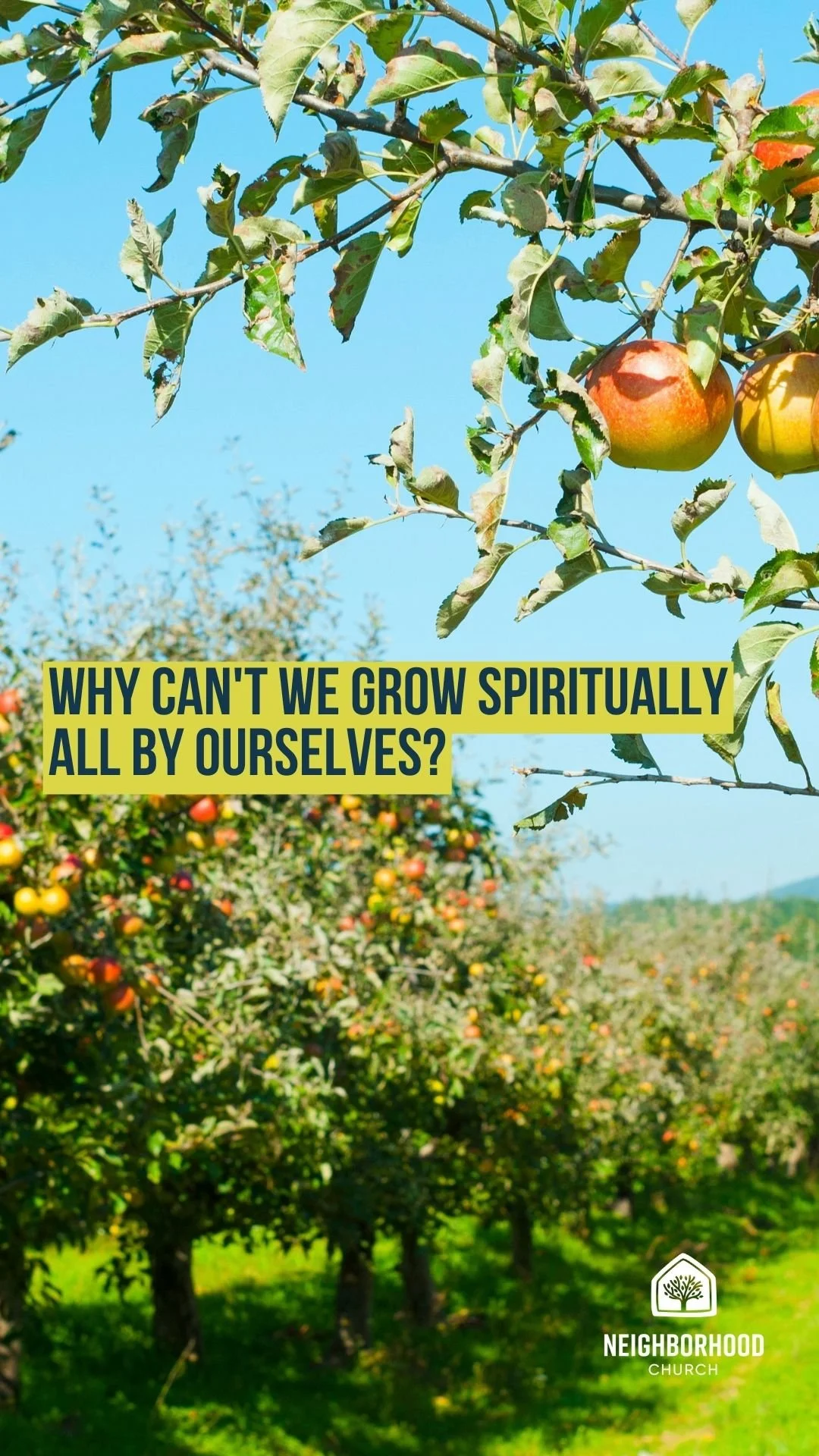

Why can't we grow spiritually all by ourselves?
If you could change one thing about your life to make it better, what would it be? More money? More time? Maybe you would take something away instead, a stressful job or a hard relationship.
Most of us have an idea of what the good life looks like. For many of us it means comfort: a life where nothing gets in our way. But Jesus had a very different vision. In his most famous sermon, recorded in Matthew 5-7, he began by describing the kind of people who are truly blessed. His list does not sound like the one most of us would write. Jesus seems far less concerned with our comfort than with our character and the kind of people we are becoming.
This is the first post in a short series at Neighborhood Church called "The Good Life." Over two weeks, we are looking at what Jesus actually says makes a life good, and comparing that to what our culture tells us.
To dig into this, we are turning to the book of Galatians, specifically the end of chapter 5 and the beginning of chapter 6. Galatians is a letter written by the apostle Paul to a church he had started. After he moved on, he heard that this congregation had begun adding their own ideas and requirements on top of the good news of Jesus. Paul writes to remind them of something simple: you cannot improve on Christ. Where you started with him is how you finish. Just follow him.
The good news starts with bad news
Before we can talk about freedom, we have to talk about what we are set free from. The gospel, which simply means "good news," starts with a hard truth. Every person is born separated from God, resistant to the work he wants to do in us.
But here is the good news: Jesus saw our hostility toward God and, instead of responding in kind, chose to love us. He laid down his life as a sacrifice to pay for our sin, the very thing that separated us from God. We know his sacrifice was accepted in full because three days after his death, he rose again. The debt was paid completely. Now Jesus offers that forgiveness to you freely. It cost him everything, but he gives it to us at no cost. That is grace.
Freedom was never meant to be selfish
Once we understand what we have been saved from, the next question is what we do with that freedom. Paul writes:
For you were called to freedom, brothers. Only do not use your freedom as an opportunity for the flesh, but through love serve one another. For the whole law is fulfilled in one word: "You shall love your neighbor as yourself." (Galatians 5:13-14, ESV)
Being set free from sin does not mean we get to do whatever we want. It means we are free to serve one another in love. Paul goes on to describe two very different ways of living: gratifying our natural desires (the flesh), or walking by the Spirit.
But the fruit of the Spirit is love, joy, peace, patience, kindness, goodness, faithfulness, gentleness, self-control; against such things there is no law. And those who belong to Christ Jesus have crucified the flesh with its passions and desires. (Galatians 5:22-24, ESV)
One important note here. Crucifixion was a slow, painful form of execution. Even though our old desires have been crucified with Christ, that does not mean they are silent yet. They may still call out to us, promising a satisfaction they cannot deliver. Growth takes time, and that is normal.
The fruit of the Spirit is not a solo project
Notice something about that list: love, joy, peace, patience, kindness, goodness, faithfulness, gentleness, and self-control. Every one of them is relational. You cannot love in isolation. Joy is most visible in the middle of conflict, not when we are alone in comfort. Peace with God is expressed through peace with other people.
Our personal relationships often reveal the true condition of our relationship with God. We only have one heart. It does not divide neatly into separate compartments, one for God and one for everybody else. If we are holding on to bitterness toward someone who hurt us, that will show up in how we relate to God too.
So ask yourself: what do your closest relationships reveal about your relationship with God?
Spiritual growth is a community project
Right after describing the fruit of the Spirit, Paul turns and says something that may sound life a huge shift in topic.
Brothers, if anyone is caught in any transgression, you who are spiritual should restore him in a spirit of gentleness. Keep watch on yourself, lest you too be tempted. Bear one another's burdens, and so fulfill the law of Christ. For if anyone thinks he is something, when he is nothing, he deceives himself. But let each one test his own work, and then his reason to boast will be in himself alone and not in his neighbor. For each will have to bear his own load. (Galatians 6:1-5, ESV)
Notice the picture here. It is not that each of us grows our own individual tree with nine kinds of fruit hanging on it. Instead, God grows His fruit across an entire orchard of people. Spiritual growth was never meant to happen in isolation.
Right alongside the fruit of the Spirit, this passage highlights a few more qualities God grows in us through relationship with others: compassion, humility, endurance, and responsibility. Compassion means caring enough to get involved in someone else's struggle instead of assuming they will figure it out on their own. Humility means recognizing we are not above correction. Endurance means carrying a burden alongside someone, not just feeling sorry for them from a distance. And responsibility means still owning our own part, since each of us will ultimately answer for our own actions.
Notice too the word Paul uses: restore. Not “correct.” Not “condemn.” If someone in your life is caught in sin, the goal is not to tell them how wrong they are. It is to gently bring them back, to restore them.
Many of us grew up thinking church was for people who already have it together, but nothing in Scripture describes church that way. Right after this description of the fruit of the Spirit, Paul assumes people will get caught in sin, and he tells us how to respond: with gentleness, not judgment.
Here is the good news for anyone who feels they could never walk into a church because of what they are struggling with: there is nothing about you that would surprise Jesus. He already knows, and he still welcomes you.
You reap what you sow
Paul closes this section with a picture of harvest.
Do not be deceived: God is not mocked, for whatever one sows, that will he also reap. For the one who sows to his own flesh will from the flesh reap corruption, but the one who sows to the Spirit will from the Spirit reap eternal life. And let us not grow weary of doing good, for in due season we will reap, if we do not give up. So then, as we have opportunity, let us do good to everyone, and especially to those who are of the household of faith. (Galatians 6:7-10, ESV)
This passage adds a few more qualities to the list of the Spirit’s fruit: generosity, discernment, and perseverance. Generosity shows up in sharing good things with those who teach and lead us. Discernment helps us tell the difference between investing in our own flesh and investing in the Spirit. Perseverance keeps us going even when doing good feels exhausting.
God gives growth where we sow. If we invest our attention in self-gratification and isolation, that is exactly what we will reap: more isolation. But if we invest in the Spirit, even when we do not feel equipped for it, God grows something real in us. Peace in people who have never known peace. Joy in people who tend toward grumpiness. Self-control in people who have never had much of it.
Why this matters for all of us
Church is meant to be a place where people who have almost nothing else in common become close friends because of what Jesus has done. It is not always tidy. It is often messy. But that is exactly the kind of community where the Holy Spirit grows the good life in us, using the people around us.
So what areas of your life are you giving the most attention to right now? Where might God be inviting you to stop sowing to your own comfort and start sowing to the Spirit, alongside others who are trying to do the same?
If you are local to Ocala and want to talk more about any of this, or want to find a community where you can walk this out with others, reach out to us at ocala@weareneighborhood.church or text us at 352-236-2211. If you live outside our area, we would encourage you to find a local church nearby where you can keep asking these questions and grow together with others who are following Jesus.
Editor note: This blog summary was generated from a sermon transcript processed by AI and reviewed by a human editor. It is provided for convenience and engagement but may not fully reflect all of the original sermon emphases or explanation. The original writing and delivery of the sermon were done without the input of AI. Please refer to the full message and more importantly the Scripture for complete context and teaching.