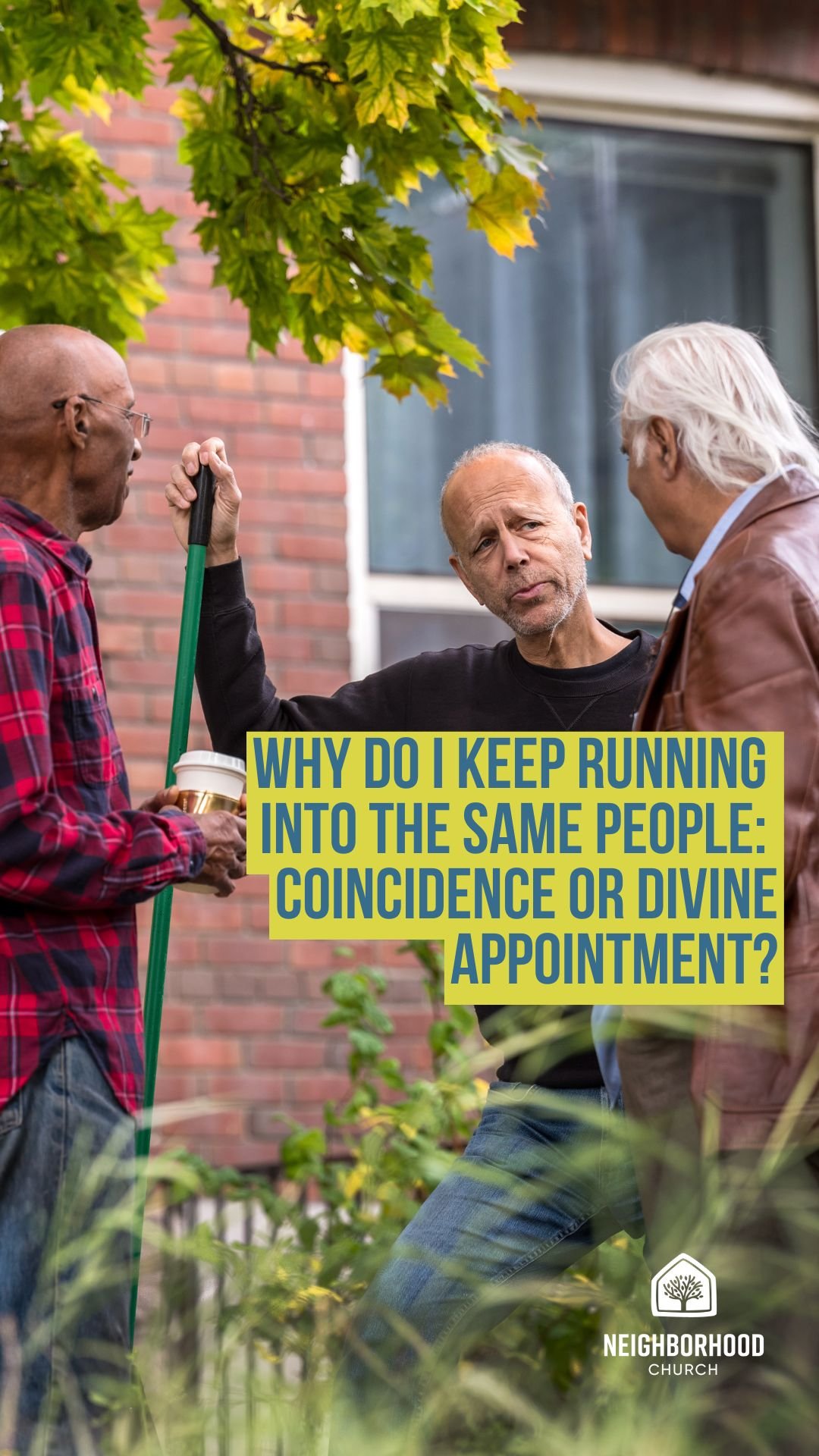

Why do I keep running into the same people: coincidence or divine appointment?
Recently, we had the privilege of hearing from Pastor Paul Mutchler, a pastor with decades of ministry experience who's seen God work in countless ways. His message centered on one of the most overlooked gifts in the Christian life: encouragement.
And here's his thesis: Encouragement is the greatest gift because you can both give it and receive it.
That might sound simple, but think about it. How many people who desperately need encouragement but never receive it because they stay away from church, already convinced no one cares? Or how many folks are doing well and just keep it to themselves rather than encouraging others?
The writer of Hebrews understood this tension: "Let us not give up meeting together, as some are in the habit of doing, but let us encourage one another—and all the more as you see the Day approaching" (Hebrews 10:25).
We gather not just to receive, but to give. To strengthen one another. To instill courage. To spur each other on.
But here's the question that should make us uncomfortable: What if we're surrounded by divine appointments and we're missing them?
The Bible's model encourager
If you want to see what biblical encouragement looks like, look at a man named Barnabas.
His real name was Joseph, but the apostles gave him a nickname that stuck: Barnabas, which means "son of encouragement" (Acts 4:36).
Joseph was so consistently, remarkably encouraging that people stopped using his real name and just called him "the Encourager."
What did that look like practically? The Bible shows us four ways Barnabas encouraged others—and they're patterns we can follow today.
1. Encouragers see needs and meet them
In the early church, believers were sharing everything they had. No one claimed exclusive ownership of their possessions—they took care of each other (Acts 4:32-35).
Barnabas sold a field he owned and gave the money to the apostles to distribute to those in need (Acts 4:36-37).
He didn't just feel bad for people struggling. He didn't just pray about it. He saw a need and met it.
Encouragement isn't just words. Sometimes it's action. Sometimes it's sacrifice. Sometimes it's giving what costs you something to help someone else.
2. Encouragers vouch for the unlikely
Here's where Barnabas's story gets really interesting.
After the Apostle Paul's dramatic conversion (he went from violently persecuting Christians to claiming Jesus appeared to him), he tried to join the disciples in Jerusalem. But they were terrified of him (Acts 9:26).
This was like a former terrorist showing up at church saying, "I'm on your team now!" Reasonable people would be suspicious. It could be a trap.
But Barnabas took him, brought him to the apostles, and vouched for him (Acts 9:27). He took a huge risk and listened to Paul's story, discerned that the Holy Spirit was confirming it, and then put his own reputation on the line to give Paul a chance.
Barnabas was a gripper: he took hold of people others rejected and brought them along.
Here's the uncomfortable question: Do we write people off too quickly? Do we look at someone and think, "They're too far gone" or "They'd never fit in here" or "That person has too much baggage"?
Barnabas saw potential where others saw problems.
3. Encouragers invest in people's growth
When the gospel started spreading to non-Jewish people in Antioch, the Jerusalem church sent Barnabas to check it out. When he arrived and saw evidence of God's grace, he was glad and encouraged them all to remain true to the Lord (Acts 11:23).
But then he did something that may be unexpected for this super-encourager. He recognized he needed help, so he went to find Paul and brought him back to Antioch. For a whole year, Barnabas and Paul taught the people there (Acts 11:25-26).
Barnabas was a grower—he invested time and energy into deepening people's faith.
A year. Not a weekend seminar. Not a quick fix. A full year of consistent, patient teaching.
Real encouragement takes time. It's not just a pep talk. Real encouragement is walking alongside someone, helping them understand God's word, praying and watching as they mature.
4. Encouragers give second chances
Here's where the story gets messy and more like our real life.
Paul and Barnabas took a young man named John Mark with them on a missionary journey. But John Mark abandoned them partway through (Acts 13:13). We don't know why (homesickness, family issues, fear) but it is clear that he left the group.
Later, when planning another trip, Barnabas wanted to give John Mark a second chance but Paul refused (Acts 15:37-38).
The disagreement was so sharp that these two ministry partners split up. Barnabas took John Mark and went one direction. Paul took someone else and went another.
It would be a heartbreaking story if we weren't paying attention to how it turned out. Years later, Paul wrote that John Mark was "useful" to him in ministry (2 Timothy 4:11). Peter was so invested in this young man he called him "my son" (1 Peter 5:13). And John Mark went on to write a little part of the Bible we call the Gospel of Mark.
Barnabas believed in second chances—and he was right.
Sometimes encouragement means believing in someone when they've failed. It means seeing who they can become, not just who they've been.
So what does this mean for us?
Here's where the rubber meets the road.
Who does encouragement? You do. We all do. It's not reserved for pastors or "spiritual" people. Every follower of Jesus is called to encourage others.
Who needs encouragement? Everyone. The person sitting next to you in church. Your coworker. Your neighbor. The stranger at the grocery store who looks exhausted.
When do you do it? Now. Not "someday when I'm more mature" or "when I have more time." Now.
Where should you do encouragement? Where you are. You don't need to join a program or get special training. You just need to pay attention to the divine appointments right in front of you.
Your neighborhood is your mission field
Here's a startling reality: If you live in a typical neighborhood, you're surrounded by hundreds of people who need encouragement. People right next door. People you pass on your daily walk. People at the coffee shop you frequent.
What if they're not random strangers? What if they're divine appointments?
The Great Commission—Jesus's command to "go and make disciples"—isn't just about overseas missions. The word translated "go" is actually an assumption: "As you're going—in your daily life, at work, at the store, in your neighborhood—make disciples" (Matthew 28:19-20).
You don't have to travel far to make an impact. God has strategically placed you exactly where you are.
Don't be a "let them" church
A lot of churches have become "let them" churches.
Jesus commanded us to go and make disciples. We sit back and say, "Yeah, let them do that. Let the missionaries do it. Let the pastor do it. Let someone else handle it."
But what if you are the "someone"?
What if the person who desperately needs a word of encouragement is your neighbor, and you're the only Christian they know? What if God has been nudging you to reach out to that coworker, that family member, that person you keep running into?
Practical steps to become an encourager
1. See needs and meet them. Look around. Who's struggling? Who needs help? Don't just feel bad, do something! Even small acts of service communicate, "You matter. I see you."
2. Take hold of the unlikely. Who have you written off? Who seems too broken, too far gone, too different? God specializes in transforming the unlikely. Don't assume difficult people are beyond His reach.
3. Invest in growth. Encouragement isn't just a one-time thing. It's consistent, patient investment. Invite someone to coffee. Read the Bible together. Pray for them. Walk alongside them over time.
4. Give second chances. People fail. They disappoint. They let you down. Will you be like Barnabas and believe in who they can become? Or will you write them off after one mistake?
The greatest encouragement of all
Here's the foundation of everything we've been talking about: We can encourage others because God first encouraged us.
When we were enemies of God—broken, rebellious, lost—He didn't write us off. He gave us Jesus (Romans 5:8). He vouched for us when we didn't deserve it. He saw potential in us when we were messes.
That's the ultimate encouragement: God pursued us with relentless love.
And now He calls us to do the same for others. Not because we're perfect, but because we've been encouraged by the God who never gives up on us.
Your move
So here's the question you need to wrestle with: Who is God putting in front of you right now?
The neighbor you wave at but never really talk to?
The coworker who seems lonely?
The family member who's struggling?
The person who failed and needs a second chance?
Don't wait for the perfect moment. Don't wait until you feel more qualified. Don't wait until you have all the answers.
Just show up. Be present. See the need. Meet it. Vouch for someone. Invest time. Give grace.
Be a Barnabas.
Because here's the truth: Encouragement is the greatest gift you can give and receive. And when you start looking at the people around you as divine appointments instead of random strangers, everything changes.
Your neighborhood isn't just where you live. It's your mission field.
So who will you encourage today?
If you're wondering how to start:
Begin with prayer. Ask God to open your eyes to the people He's placed around you. Ask Him to give you courage to step out of your comfort zone. Ask Him to make you into someone who is known for building others up, vouching for the unlikely, investing in growth, and giving second chances.
And if you need encouragement yourself—if you're struggling, doubting, or barely hanging on—reach out. That's why we gather. That's why the church exists. We need each other.
Contact us at ocala@weareneighborhood.church. We'd love to walk with you, pray with you, and remind you that God sees you. He hasn't given up on you. And you're not alone.
Now go be the encouragement someone desperately needs today.