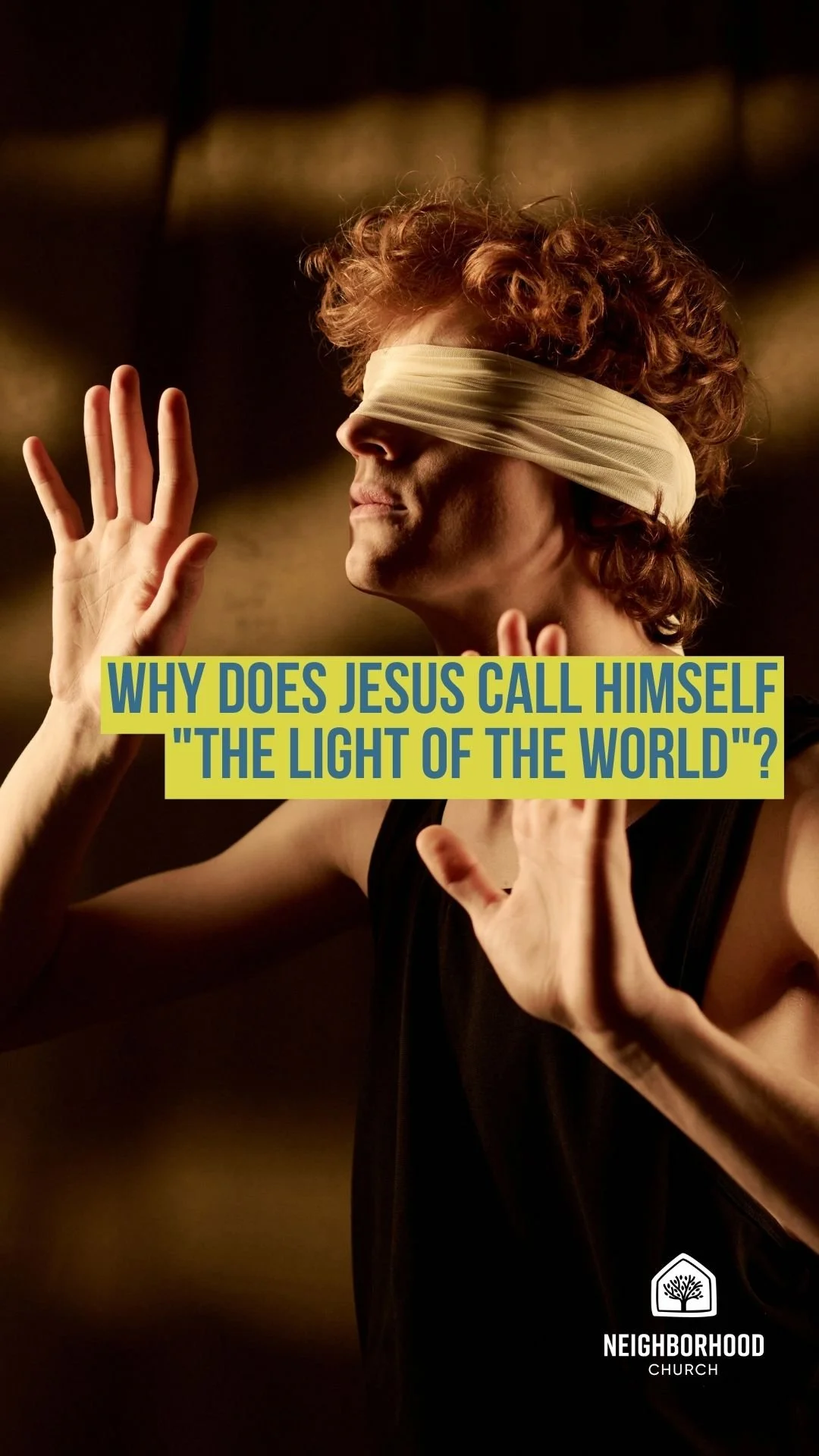

Why does Jesus call himself "the light of the world"?
Have you ever walked into a dark room and immediately reached for the light switch? You can't do much in the dark. You stumble, you bump into things, you guess at what's in front of you. Light changes everything — not because it changes the room, but because it lets you see the room for what it actually is.
That's exactly the picture Jesus paints when he says, "I am the light of the world. Whoever follows me will not walk in darkness, but will have the light of life." (John 8:12)
It's a bold statement. And it raises a fair question: what does that actually mean for regular people trying to navigate real life?
Jesus said it about himself
At Neighborhood Church, we've been spending a few weeks looking at something specific: what did Jesus actually say about himself? Not what people say about him online, not what you may have heard growing up, not the cultural version of Jesus — but his own words.
In John 8, Jesus is in Jerusalem during a major Jewish festival called the Feast of Booths (also called the Feast of Tabernacles). This was a week-long celebration where Jewish families camped outside to remember how God took care of their ancestors in the wilderness — when they had nothing, and God still provided food, water, and protection (Leviticus 23:42-43).
During this festival, the city came alive in a really specific way. Priests would carry water from a nearby spring called the Pool of Siloam up to the temple in a joyful parade — a picture of God's provision. And in the temple courtyard, they would light enormous torches made from the retired robes of priests. These torches were so large, so bright, that you could see light in every courtyard in the city — the only week of the whole year that Jerusalem had public lighting after dark.
Picture it: the whole city lit up, full of celebration and hope.
Right in the middle of that moment, Jesus stands up and says, "I am the light of the world."
He wasn't just being poetic. He was saying: I am the thing this whole festival is pointing to. The water, the light, the provision — that's me.
Truth doesn't need your permission
The religious leaders of the day (called the Pharisees) pushed back immediately. Their argument wasn't "that's an interesting claim, tell me more." It was more like: "You can't say that about yourself. Technically, legally, you need two witnesses for a testimony to count."
They dodged the message by attacking the procedure.
Jesus' response is worth sitting with. He says, "Even if I do bear witness about myself, my testimony is true, for I know where I came from and where I am going." (John 8:14)
In other words: just because you can't prove something doesn't mean it isn't true.
Imagine that someone believes with everything in them that they can fly. But if that person jumps off a building, gravity doesn't care about their belief. Truth is the nature of reality and it isn't shaped by anyone's opinion, feelings, or ability to verify it.
The Pharisees knew their scriptures inside and out. They had memorized entire books of the Bible. And yet Jesus looked at them and said, "You know neither me nor my Father." (John 8:19) You can have all the right information and still completely miss the point.
That's a little uncomfortable, right? It's worth asking: what truths are we demanding God prove before we're willing to trust him?
A jaw-dropping claim
The conversation in John 8 keeps going, and it gets intense. The Pharisees start attacking Jesus personally — calling him a Samaritan, accusing him of being possessed. When people don't like the truth being spoken, it's not unusual to go after the person saying it.
But Jesus doesn't waver. He doesn't need their approval. He says: "It is my Father who glorifies me." (John 8:54) He already has everything he needs from God — he doesn't need a standing ovation from the crowd.
And then he says something that makes the whole crowd want to throw rocks at him.
"Before Abraham was, I am." (John 8:58)
Abraham was a central figure in Jewish history who lived roughly 2,000 years before Jesus. Saying "I existed before Abraham" was already wild. But Jesus didn't say "I was" — he said "I am."
That phrase — I am — is the personal name God used for himself when Moses asked who was sending him (Exodus 3:14). Jesus was directly claiming to be the timeless, uncreated God of the universe. Not a prophet. Not a teacher. God himself.
The crowd understood exactly what he meant. That's why they picked up stones.
What it looks like in real life
As Jesus is walking away from that hostile crowd, something happens that ties everything together. He passes a man who has been blind since birth. His disciples ask: "Who sinned — this man or his parents?" (John 9:2)
Jesus says neither. This man's blindness isn't a punishment — it's an opportunity for God to show up. And then Jesus heals him, sending him to wash in the same Pool of Siloam that had been the center of the festival celebration all week.
The man came back seeing.
In the midst of this miracle of sight Jesus says it again: "As long as I am in the world, I am the light of the world." (John 9:5)
He doesn't just say he's the light. He shows what it looks like. He opens blind eyes.
At the end of the story, the Pharisees ask sarcastically: "Are we also blind?" (John 9:40) And Jesus says something striking: if they admitted they couldn't see, they'd be in a better position with God and truth. But they keep insisting they already see everything clearly and have nothing to learn from Jesus.
As you reflect on your own life don't let your own certainty block God's invitation.
What does this mean for you?
Jesus lights up things we cannot see on our own. That's the heart of it.
You might be someone who has been trying to think your way through a problem that won't budge. You may be carrying something you've never been able to put down. Perhaps you’re looking everywhere for answers — the internet, other people's opinions, your own past experiences — and still coming up empty.
Jesus says: come to me. Not because you have to have everything figured out first. Not because you need to be religious enough or know enough Bible verses. But because he's the light — and without light, we're just stumbling around in the dark.
The lights are either on or they're off. There's no neutral middle ground.
If something in this resonates with you — if you feel like there's something here worth exploring — we'd love to have you join us at Neighborhood Church in Ocala. And if you want to dig into the scriptures mentioned here, start with John 8 and John 9. Read them slowly. Ask your questions. Jesus can handle them.
Turn to him.