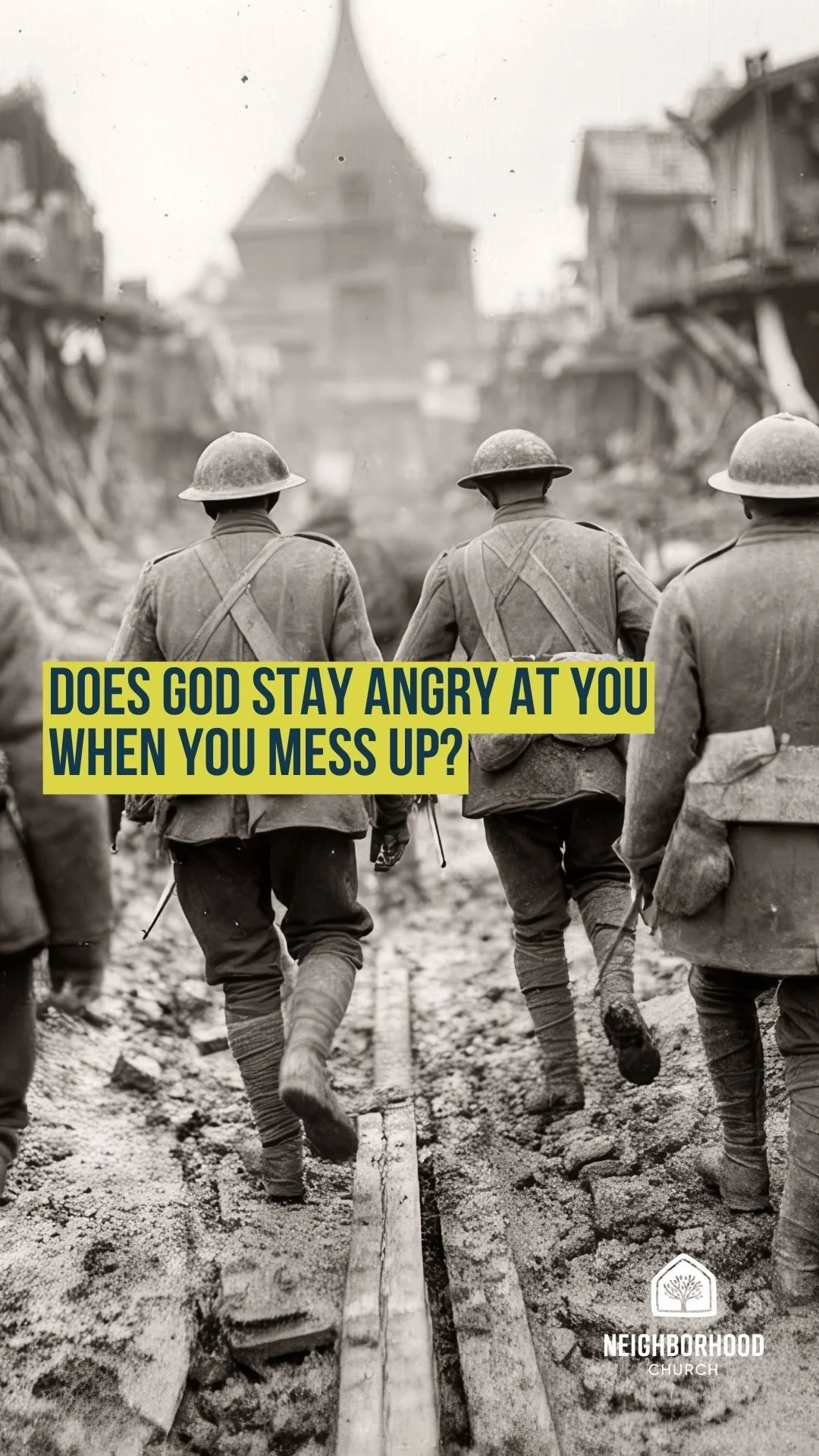

Does God stay angry at you when you mess up?
Most of us picture God something like a disappointed parent. Arms crossed. Quiet. Waiting for you to come back, admit what you did, and start cleaning up the mess. You might be forgiven — eventually — but you'd better earn it first.
That picture is understandable. It's also completely backwards, according to the Bible.
At Neighborhood Church, we've been working through a series called Fruit of the Root, exploring what happens when Jesus is genuinely at work in someone's life. We've looked at love and joy already. This week, we're looking at peace — and what we found might be different from what you'd expect.
We start farther from peace than we think
In the book of Galatians, Paul lists the fruit of the Spirit — the qualities God grows in people who follow Jesus. Peace is right there in the middle of the list. But to understand why peace matters, we have to start with an uncomfortable truth.
In Ephesians chapter 2, Paul writes to a group of early Christians and reminds them of where they started:
“Remember that you were at that time separated from Christ... having no hope and without God in the world.” (Ephesians 2:12)
Most of us wouldn't naturally describe ourselves as enemies of God. We'd say something more like, "I'm pretty neutral on the whole God thing. I'm not against him, I just have some questions." But the Bible draws a hard line: you're either at peace with God or you're not. And our default apart from Jesus, is that we're not at peace.
That's not an insult. It's actually the starting point for the best news in the world.
Peace has always come at a cost
Even in the oldest parts of the Bible, peace wasn't free. In the book of Leviticus, God gave the nation of Israel a system of "peace offerings" — animal sacrifices designed to restore the relationship between people and God when something had gone wrong. Every time they made one, it was a reminder: conflict with God is real, and repairing it costs something. As one scholar puts it, peace “exacts the high cost of life.” Something dies in order to show that we've made peace.
That system wasn't meant to be the final answer. It was meant to show people something important — that they couldn't fix the problem on their own, no matter how many times they tried. The offerings had to keep being made because the heart never fully changed on its own.
But then Jesus came.
Jesus is our peace.
Here's the line that changes everything. Paul writes in Ephesians:
“But now in Christ Jesus, you who were once far off have been brought near by the blood of Christ. For he himself is our peace.” (Ephesians 2:13-14)
The Christian faith is not a self-improvement plan. It's not about following the right rules, knowing the right people, or suffering enough to prove how sorry you are. It's about one thing: Jesus himself going to the cross to pay what we owed and rising from the dead to prove the debt was cleared.
Think of it like this: if you write a check, you're not sure it's going to clear until you see it come through. Jesus went to the grave to pay for our sin. The resurrection was God the Father saying, “The payment cleared. You're free.”
What's remarkable — and honestly kind of shocking — is that in this story, it's the offended party who makes the peace. We're the ones who walked away from God. We're the ones who said, "I'd rather run my own life, thank you." And yet God is the one who made the arrangements to fix it. He sent his son to pay what we couldn't pay, and then he offers us the peace as a gift.
We don't earn it. We trust that it's already been paid.
So what are you looking to for peace?
Here's a question worth sitting with honestly: what do you actually turn to when you need peace? Not what you think you're supposed to say — what do you actually do?
Maybe you need to talk it out, again and again, until the anxiety gets quiet. Maybe you work harder, chase the next paycheck or the next achievement, hoping that something will finally feel like enough. Maybe you just need a little something to take the edge off at the end of the day.
None of those things are working as well as we'd like them to, if we're honest.
The peace the Bible describes is different. It's not the absence of conflict or the feeling you get when everything is finally going right. It's a settled confidence — even on a hard Tuesday — that you are at peace with the One who made you. That whatever you've done, whatever you're carrying, the debt has been paid and you are not at war with God anymore.
When we close our eyes at night, do we rest secure, knowing that regardless of anything else in our life, Jesus has made peace between us and our Maker?
That peace is available to anyone. Not just people who grew up in church. Not just people whose lives look clean from the outside. Jesus will give peace to anyone who comes to Him and asks.
Peace doesn't stay private
There's one more thing worth noting. The peace Jesus gives doesn't stay contained inside one person. Paul writes that Jesus “has broken down in his flesh the dividing wall of hostility” (Ephesians 2:14) — not just between us and God, but between people who had every reason to stay divided.
If God can make peace between himself and us — after everything — then the peace he grows in us should start changing how we treat the people around us. Our neighbors. Our families. Even the people we find difficult. The fruit of peace is never just “vertical.” It shows up “sideways” too.
That's what the church is supposed to look like: people from all different backgrounds and stories, being built together into something none of them could have built on their own.
The invitation
If you've never settled the question of where you stand with God, today is a good day. There's no formula or magic prayer. Just an honest conversation with Jesus that might sound something like: “I know I haven't really been neutral. I've been doing things my way. Would you forgive me and make peace between us?”
That's it. The price has already been paid. The offer is open.
And if you want to keep exploring, we'd love to connect with you. If you're near Ocala, Florida, come find us — we'd love to meet you in person. If you're farther away, we encourage you to find a local church where you can keep asking questions and walking this out with others. Faith was never meant to be a solo project.
Editor note: This blog summary was generated from a sermon transcript processed by AI and reviewed by a human editor. It is provided for convenience and engagement but may not fully reflect all of the original sermon emphases or explanation. The original writing and delivery of the sermon were done without the input of AI. Please refer to the full message and more importantly the Scripture for complete context and teaching.