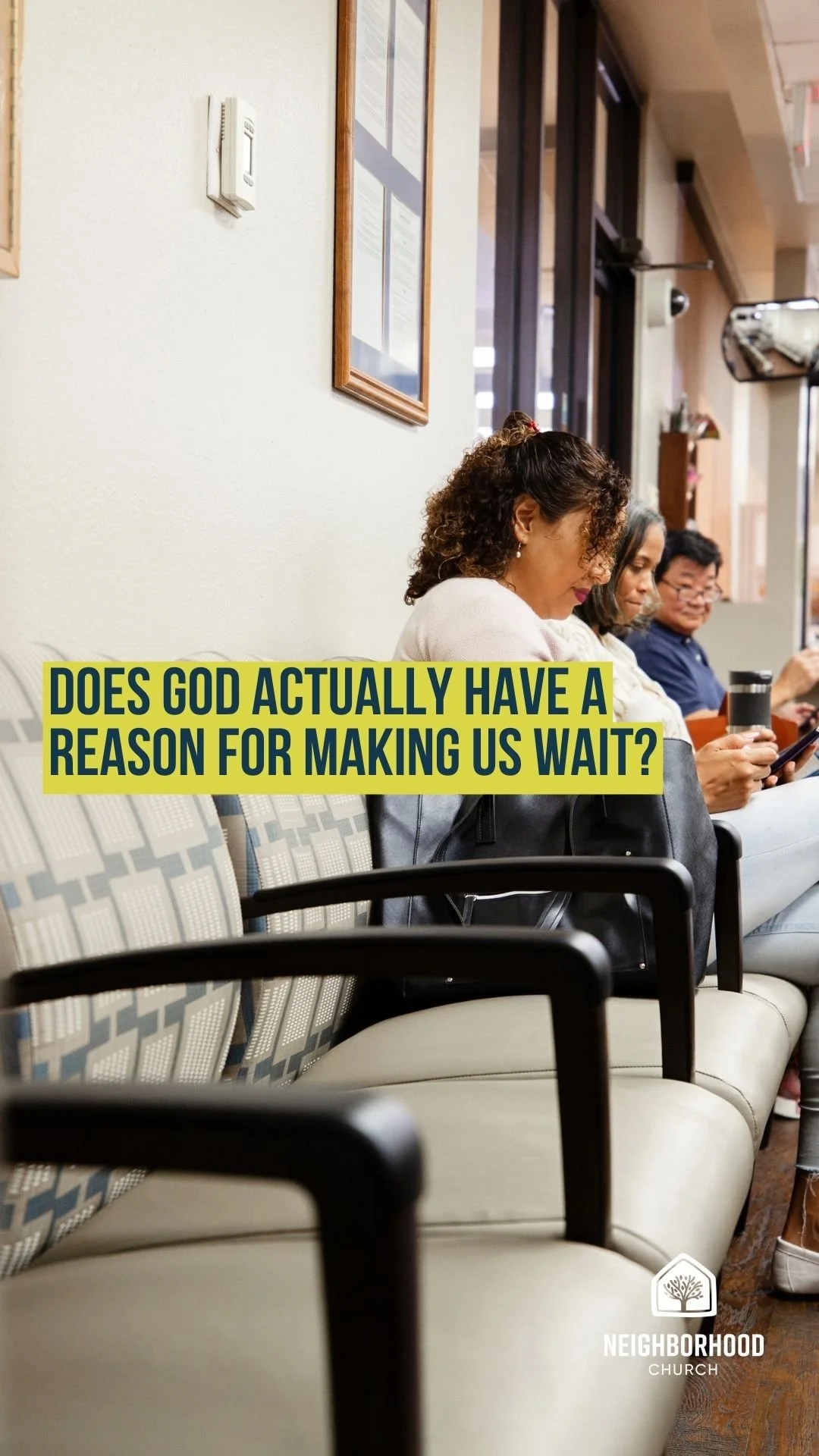

Does God actually have a reason for making us wait?
Nobody likes waiting. Whether it's a difficult situation that won't resolve, a relationship that won't heal, or a prayer that seems to go unanswered — waiting is one of the hardest things we do. And if we're honest, most of us are not very good at it.
At Neighborhood Church, we've been working through a series called Fruit of the Root, exploring the qualities that God grows in people who follow Jesus. So far we've looked at love, joy, and peace. This week we're talking about patience — and it might be the fruit we need most right now.
Where patience comes from
In the book of Galatians, the apostle Paul lists what he calls the "fruit of the Spirit" — qualities that God grows in us when we surrender our lives to Jesus. The list includes love, joy, peace, patience, kindness, goodness, faithfulness, gentleness, and self-control. These aren't things we manufacture through willpower. They grow in us the way fruit grows on a tree — gradually, and only when the conditions are right.
Patience is on that list. And the book of James gives us a really practical picture of what it looks like.
The farmer knows something we don't
James writes:
“Be patient, therefore, brothers, until the coming of the Lord. See how the farmer waits for the precious fruit of the earth, being patient about it until it receives the early and the late rains.” (James 5:7)
If you've ever tried to grow anything — even just a single tomato plant — you know how true this is. You can get the right soil, water on schedule, read every gardening tip online. But you cannot make the tomato grow. The best you can do is set up an environment and then wait.
For a farmer, the stakes are enormous. If the crops don't come in, the family doesn't eat. There's no backup plan. And yet, for all the work they put in every single day, the one thing they absolutely cannot do is force the harvest. They have to wait on the rain.
That's not an accident. God designed creation to model our relationship with him. He has built into the rhythms of life a reminder that we are not God — that there are things we cannot control, cannot rush, cannot manufacture on our own. And when we find ourselves in those moments, what he's asking us to do is wait.
You already have what you need for today
One of the most common fears around patience is that we just don't have enough of it. We feel like patience is a fixed resource — some people got a lot, some people got a little — and we drew the short straw.
But consider this: a parent doesn't have patience for six kids on the day they bring home their first. They develop it over time, in real situations, as the need arises. God gives us what we need for the day we're in. As we pray each week, “give us this day our daily bread” (Matthew 6:11) — that's not just about food. It's about trusting that the grace, the strength, and yes, the patience we need will be there when we actually need it.
You have enough time and enough capacity to live the life God intends for you. Sometimes impatience is really just us trying to live a different life than the one God has laid out for us — trying to force a result, squeeze more out of less, or rush a process that was never meant to move that fast.
Establish your heart, not your plan
James continues:
“You also be patient. Establish your hearts, for the coming of the Lord is at hand.” (James 5:8)
Establish your heart. Not your circumstances. Not your timeline. Establish your heart.
When we're in a season of waiting, something in us wants to fix, to move, to control something — anything. But the instruction here is to stabilize. Settle. Not because nothing is happening, but because something very much is. Jesus is coming back. He is on his way. And if he came the first time exactly when he promised — which the Old Testament prophecies confirm in remarkable detail — then we can trust he'll be on time again.
Our stability rests in God's activity. We're not just killing time. We're waiting for someone specific, and he has never once been late.
Waiting rooms and grumbling
Here's the part that hits close to home. James adds:
“Do not grumble against one another, brothers, so that you may not be judged. Behold, the judge is standing at the door.” (James 5:9)
Think about sitting in a waiting room. After a while, you start looking around. How long have they been here? Did I arrive before them? Why did they get called back first? The other people in the room — who have nothing to do with your situation — start to feel like the problem.
That's what happens when impatience goes sideways. It doesn't just make us anxious. It makes us irritable and unkind to the very people around us who are also just trying to get through the day.
Patience isn't only about enduring hard circumstances. It's about being gentler with other people's failures. It's about being slow to take offense and slower to take revenge. The same God who is patient with us — and he is extraordinarily patient with us — is asking us to extend some of that to the people around us.
God has been here longer than we have
When Moses received the Ten Commandments, he actually broke the first set. And when he went back to God and asked for another copy, here is how God described himself:
“The Lord, the Lord, a God merciful and gracious, slow to anger and abounding in steadfast love and faithfulness.” (Exodus 34:6)
He didn't just say that at the beginning, when it was easy. He said it again, the second time around, after the mess. That's what makes it mean something. It's one thing to make a promise before you know what you're getting into. It's another to keep it 40 years in.
God is patient. He is long-suffering. And the fruit he wants to grow in us looks like him.
We wait better together
One of the hardest things about difficult seasons is the isolation — facing uncertainty alone, carrying the weight of it without anyone sitting with you.
Community isn't just a nice bonus to faith. It's part of how God designed the process. We wait better when we wait with others.
God is not only at work in your life individually. He's working in all of us together, and he uses the people around you to grow things in you that couldn't grow any other way.
So as you sit with whatever you're waiting on, let us ask: who in your life is most likely to be the victim of your impatience? And what might your impatience be revealing about what Jesus wants to grow in you?
You don't have to have it figured out to take a next step. If you're exploring faith and want to keep the conversation going, we'd love to connect. You can reach us through our website. If you're not in the Ocala area, we'd encourage you to find a local church where you can ask your questions and walk this out with other people. You were not meant to wait alone.
Jesus takes all the time he needs to grow all the life he has planned.
Editor note: This blog summary was generated from a sermon transcript processed by AI and reviewed by a human editor. It is provided for convenience and engagement but may not fully reflect all of the original sermon emphases or explanation. The original writing and delivery of the sermon were done without the input of AI. Please refer to the full message and more importantly the Scripture for complete context and teaching.