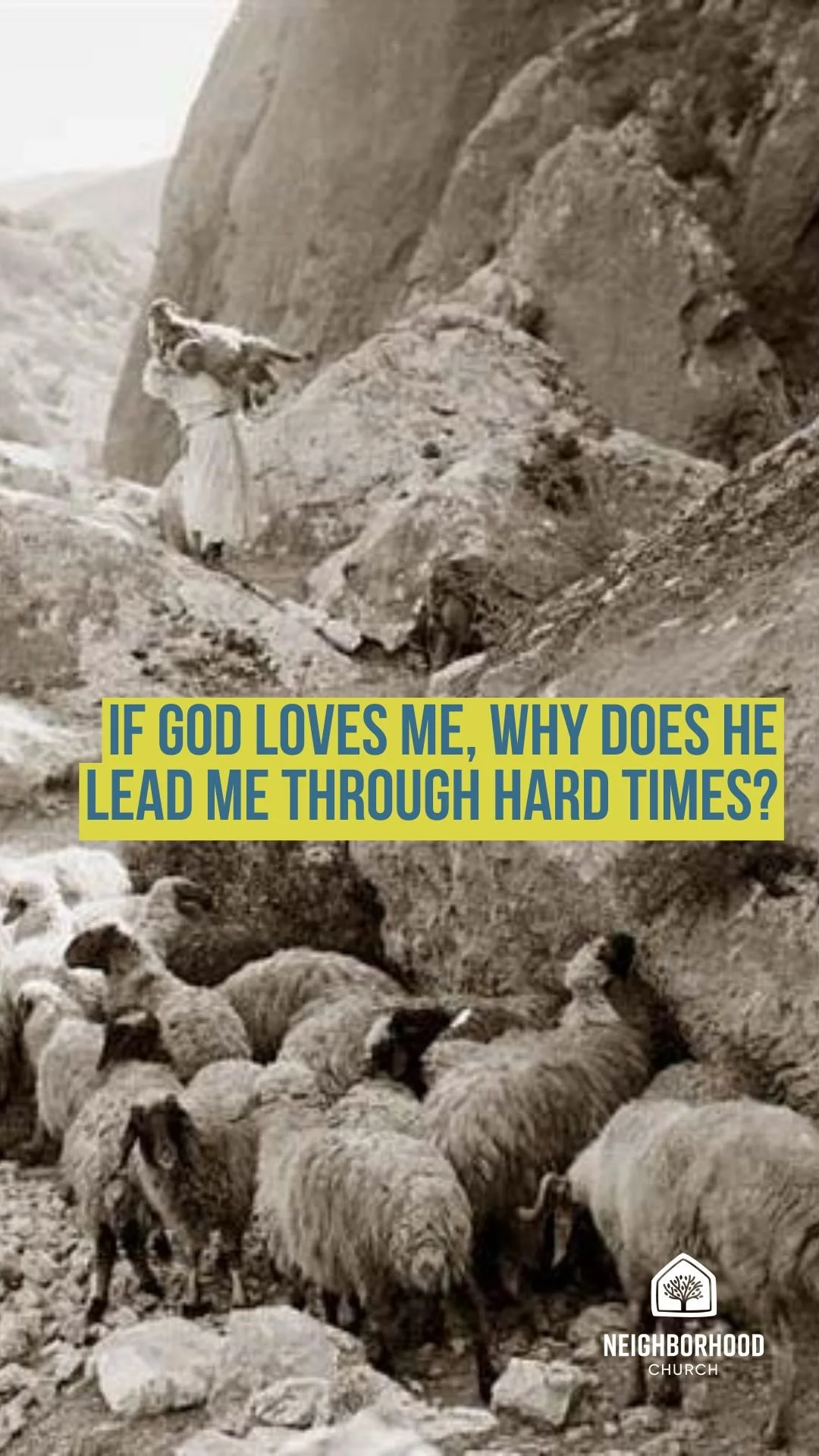

If God loves me, why does he lead me through hard times?
You know that feeling when you start a project thinking it'll take an hour, and six hours later you're still at it? You've made four trips to the hardware store, the tool you just bought broke, and you're frustrated—not just because it's hard, but because it wasn't supposed to be this hard?
Sometimes following Jesus feels like that.
We hear about green pastures and still waters in Psalm 23, and we think, "Great! Sign me up for the peaceful, easy life." But then we keep reading and suddenly we're in "the valley of the shadow of death," and we're thinking, "Wait—this wasn't in the brochure!"
So what's going on? If God is good and wants what's best for us, why does the path sometimes feel difficult? Why does he lead us out of our comfort zones?
Let's look at what Psalm 23 actually says about the journey.
Refreshment is a stop along the way, not the destination
Last week we looked at the opening of Psalm 23: "The Lord is my shepherd, I shall not want. He makes me lie down in green pastures. He leads me beside still waters. He restores my soul" (Psalm 23:1-3).
That sounds perfect, right? Green grass everywhere, peaceful water, total rest and restoration. That's where we want to stay forever.
But then verse 3 continues: "He leads me in paths of righteousness for his name's sake."
Wait—we're leaving? We just got to the good part! We were comfortable, well-fed, and rested. Why are we moving on?
Here's what we need to understand: Refreshment is a stop along the way, not our destination.
Think about it from a shepherd's perspective. If sheep stay in the same pasture too long, several things happen:
They eat all the grass down to bare mud, and then they have nothing left to eat
They start getting territorial and fighting with each other over limited resources
They become easy targets for predators because they're stationary and making noise
The flock fragments as individual sheep wander off looking for something better
A healthy flock is always moving somewhere.
This is hard for us to hear, especially in Western culture where we've been sold the idea that life should be a permanent vacation. We think the goal is to get comfortable and stay comfortable. But God knows that a flock at rest will eventually destroy itself.
So he keeps us moving. Not to punish us, but to keep us healthy.
The shepherd leads from the front
In ancient Israel, shepherds didn't drive their sheep from behind—they led from the front. The shepherd would walk ahead, and the flock would follow.
"He leads me in paths of righteousness for his name's sake" (Psalm 23:3).
God isn't behind us barking commands. He's ahead of us, saying, "I'm going where you need to go. Follow me to the place that will be most healthy for you."
There's a story about a tour guide in Israel explaining this to a group. He said, "All shepherds lead their flocks from the front." Then someone looked out the bus window and saw a man walking behind his sheep. "Hey, that shepherd's walking behind!"
They stopped to ask the man about his unusual technique. His response? "I'm not a shepherd. I'm a butcher."
Shepherds lead for our health. Butchers drive us towards slaughter.
So here's the uncomfortable question: Where are we stalling out? Where are we just laying down and refusing to move forward because we like where we are? Where is Jesus calling us forward, but we keep trying to go back to what felt comfortable before?
The voices who try to keep us comfortable and tell us to just stay put might not have our best interests in mind.
He knows the right path (even when we don't like it)
"He leads me in paths of righteousness."
Notice it doesn't say "He leads me in easy paths" or "comfortable paths" or "the paths I would have chosen for myself."
It says paths of righteousness—the right paths.
Jesus knows the right way to get where he's going. He's been leading sheep across this terrain for generations. He knows the alternate routes when one gets blocked. He knows how the landscape works together.
Sheep don't have the perspective to discern the best path. We have a knack for walking right into dangerous situations.
There's a story about a shepherd who kept rescuing the same goat over and over. This goat would wander off toward the edge of a cliff—out on a little ledge where it didn't have room to turn around and was too scared to back up. Four times the shepherd had to rope the goat and drag it back to safety.
When asked how he stayed so patient with this clearly foolish animal, the shepherd simply said: "It's just a goat. It doesn't know."
Let’s be thankful that the Lord is patient with us when we act like that goat—convinced we know better, wandering toward danger, needing to be rescued again and again.
The right path doesn't mean the safe path
Here's where it gets challenging.
"Even though I walk through the valley of the shadow of death, I will fear no evil, for you are with me. Your rod and your staff, they comfort me" (Psalm 23:4).
Wait a minute. We're following the shepherd on the right path, doing everything correctly, listening to his voice—and now we're walking through the valley of the shadow of death?
The right paths of life are not without dangers.
This is crucial to understand. Following Jesus doesn't mean everything becomes easy and risk-free. The world we live in is broken and dangerous. We have real enemies—both physical and spiritual—who want to harm us.
Some people hear "valley of the shadow of death" and say, "Oh, it's just a shadow. Only children are afraid of shadows." But here's the thing: shadows are cast by real things. The shadow of death means death is real and present.
Life in this broken world will often take us in proximity to danger. That's just reality. But we don’t have to fear.
But we don't have to fear
"Even though I walk through the valley of the shadow of death, I will fear no evil."
Not because the danger is imaginary. Not because we're particularly strong or brave (we're just sheep, after all). Not because we've been good and earned some cosmic protection.
We don't fear because the shepherd is with us.
There's a story about a young shepherd boy who was invited to see an archaeological dig inside a cave. He stopped at the entrance and refused to go in. "Nope. Don't do caves. Too dark. Too scary."
His friend tried to convince him: "Come on, I'm with you. I'll protect you." The boy shook his head. "Not going in there with you."
Later that day, the boy's father came by to see the dig site. The boy walked right in behind him without hesitation, right into the cave he'd been terrified of earlier.
"I thought you were scared!" his friend said.
The boy looked up and simply said: "My dad's with me."
Even though I walk through the valley of the shadow of death, I will fear no evil—for you are with me.
The shepherd is always equipped
"Your rod and your staff, they comfort me" (Psalm 23:4).
A shepherd's rod was basically a thick stick with a ball at one end—perfect for defending the flock against wolves and other predators. The staff was a walking stick that helped the shepherd navigate rough terrain and could be used to guide or rescue sheep.
Here's what matters: The shepherd is never without these tools. He's always ready.
There's never a moment when danger shows up and the shepherd says, "Oh no, I left my rod on the other side of the field. Let me go get it." Unlike those of us who can never find the tool we need when we need it, the shepherd is always equipped to handle whatever threatens his flock.
When we follow Jesus's direction, he handles the danger.
Not that there is no danger. Not that the path is easy. But that the way is right and the shepherd handles the danger.
Learning to recognize his voice
Jesus said it this way: "The sheep hear [the shepherd's] voice, and he calls his own sheep by name and leads them out... The sheep follow him, for they know his voice" (John 10:3-4).
In ancient times, multiple shepherds would herd their flocks into a shared enclosure at night for protection. In the morning, each shepherd would call his sheep, and out of all the sheep in that pen, only the ones belonging to that shepherd would follow his voice.
Even if different shepherds were saying similar things, the sheep could recognize their own shepherd's voice.
So here's the question: Do we recognize Jesus's voice?
Do we know his word—what he's said in Scripture? Do we know his history—how he's worked with his people across generations? Do we know his instructions well enough to follow them?
Because here's the thing: There will be other voices. False shepherds trying to lead us astray. Cultural messages that contradict what Jesus says. Our own desires telling us to wander off the path.
We need to train our ears to recognize the real shepherd's voice.
And we can't do that in the middle of the crisis. We learn to hear his voice in times of peace and security, so when we’re stumbling through the valley of the shadow of death —and we will—we already know who to follow.
You can't set a strong foundation while the storm is raging. You can't dig a well when you're dying of thirst.
Why does he lead us this way?
"He leads me in paths of righteousness for his name's sake" (Psalm 23:3).
Wait—I thought he was leading me for my sake, because he cares about me.
He does care about you. But here's something important: The reputation of the shepherd is measured by the health of his sheep.
You know this is true because you've probably heard someone say, "I don't trust Jesus because of how I've seen Christians treat each other." The shepherd's reputation rises or falls based on how his flock behaves.
When Jesus leads us in right paths, he's not just thinking about our individual comfort. He's thinking about his glory, his name, his reputation in the world. And the best way to bring glory to his name is to have a healthy, thriving flock that demonstrates his goodness.
What Jesus does is more important than what he's called. But we are called by what we do. When we follow him well, people see and recognize the good shepherd.
The invitation
So where does this leave us?
If you've never joined Jesus's flock—if you've been trying to navigate life on your own—today can be the day that changes.
You don't have to understand everything. You don't have to be perfect. You just have to say something like this:
"Jesus, I don't understand all the things, but I do know I want to belong to you. You can have all of my life because you say that you alone can forgive all my sin. Would you make me yours today? And would you lead me in the way that I should go?"
If you've been following Jesus but you've stalled out—comfortable in one place, refusing to move forward, fighting with other sheep over the same patch of grass—maybe it's time to listen for his voice again. He's calling you forward. He knows where you need to go next.
And if you're in the valley of the shadow of death right now—if life feels dark and dangerous and you're not sure you're going to make it—listen: The shepherd is with you. His rod and staff are in his hands. He's never unprepared. He handles the danger.
When Jesus is our shepherd, we lack nothing we truly need. Not "nothing we want," but nothing we truly need. And sometimes what we need isn't comfort—it's growth. Sometimes what we need isn't to stay put—it's to move forward. Sometimes what we need isn't an easy path—it's the right one, with the shepherd leading the way.
Want to learn more about hearing the shepherd's voice? The best way is to spend time reading what he's said. Start with John chapter 10 and get to know Jesus. Listen to how he speaks. Watch how he leads.
And if you have questions or want to talk with someone about joining His flock, reach out to us at ocala@weareneighborhood.church. We'd love to help you take the next step.
The shepherd is calling. Will you follow?