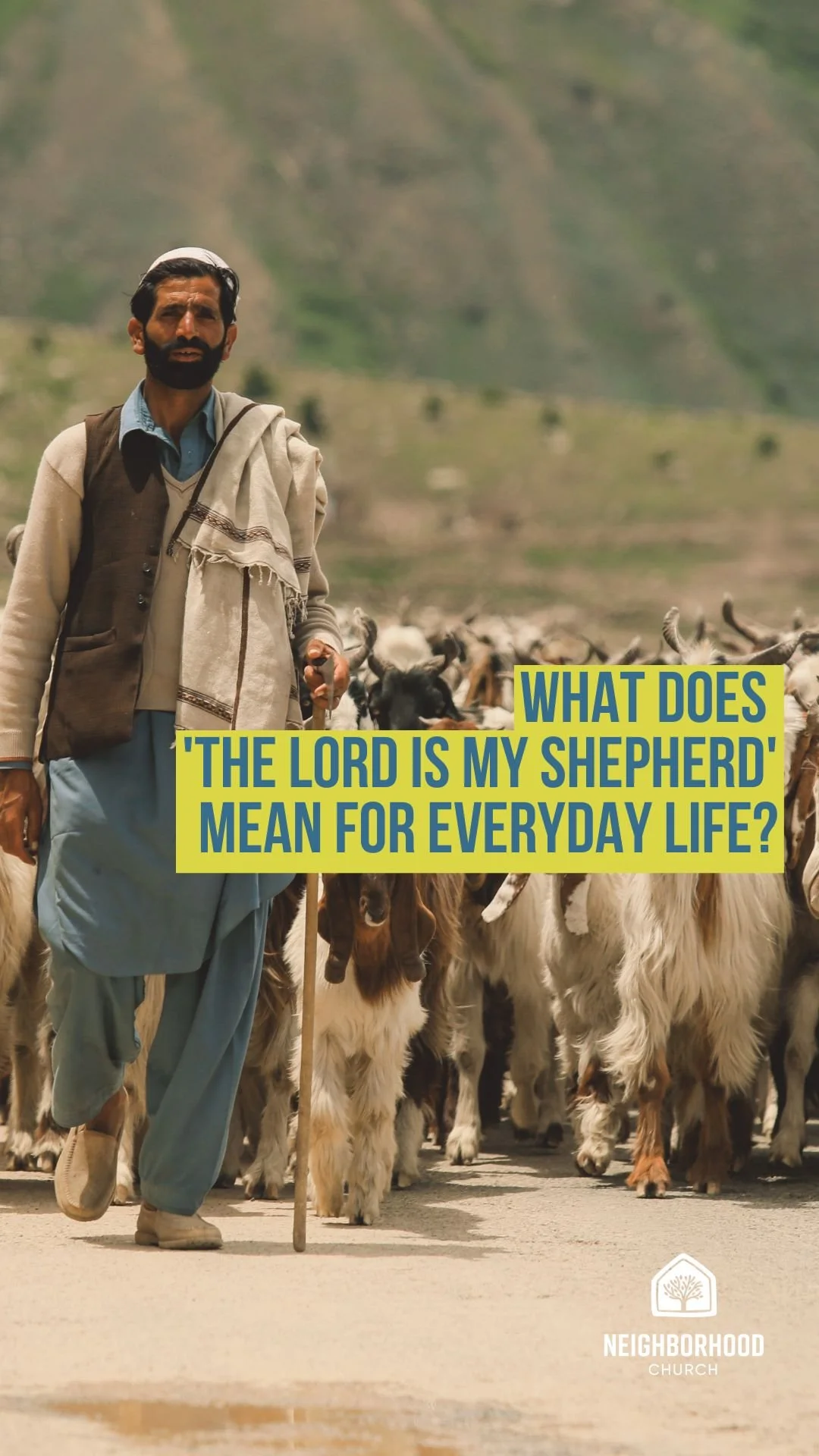

What does 'the Lord is my shepherd' mean for everyday life?
Picture this: It's one of those days that just feel heavy. You put on more formal clothes and see people you don't normally see at church. There are flowers at the front, photographs, a grieving family on display in the front row. You're going to a funeral. And at almost every funeral, someone reads the same ancient poem—Psalm 23.
"The Lord is my shepherd, I shall not want..."
Maybe you've heard these words before. Maybe they're familiar, comforting even. But here's what we often miss: By only reading this psalm at funerals, we lose so much of its beauty and promise for everyday life.
This 3,000-year-old poem, written by King David, wasn't meant just for our darkest moments. It was meant for right now—whether you're crushing your goals or barely hanging on. There's life in these words that we need to unpack and let sink deep into our souls.
So let's ask three questions that will help us really understand what this famous passage means.
Question 1: Who is "the Lord"?
"The Lord is my shepherd."
That's how the psalm starts. But who is this "Lord" we're talking about?
If you're looking at most English Bibles, you'll notice something interesting: "LORD" is written in small capital letters. That's actually a code. It's translating a specific Hebrew word: YHWH (often pronounced "Yahweh" or "Jehovah").
This isn't just any title. It's God's personal name—the name he revealed to a guy named Moses thousands of years ago.
The story goes like this: God appeared to Moses as fire on a bush and told him to go deliver the Israelite people from slavery in Egypt. Moses asked a very reasonable question: "If I tell them God sent me, they're going to ask which god. What's your name?"
At that time, people believed in gods for everything—a god of the river, a god of the sun, a god of agriculture. So Moses needed to know: Which god was sending him?
God's answer was simple and profound: "I AM WHO I AM" (Exodus 3:14).
In other words: "I'm the God who actually exists. I'm the real one. Not the made-up river god or sun god—I'm the one true God who has always been and always will be."
This name—Yahweh, "I AM"—declares God's self-existence. He wasn't created. He doesn't depend on anything. He exists outside of space and time. We experience life one second at a time, stuck in this moment, but God exists above and beyond all of it.
But what has this God done?
A name might hint at who someone is, but what someone does matters even more.
You could call someone "doctor," but if they can't actually help you when you need medical care, the name doesn't mean much. So what has Yahweh actually done?
God describes himself this way: "The LORD, the LORD, a God merciful and gracious, slow to anger, and abounding in steadfast love and faithfulness, keeping steadfast love for thousands, forgiving iniquity and transgression and sin" (Exodus 34:6-7).
Wait—slow to anger? Merciful and gracious?
That might not match what you've heard about God. Maybe you've been told God is angry, vindictive, impossible to please. But that's not what the Bible says.
The Hebrew word translated "steadfast love" is chesed. This word describes God's unwavering commitment to do what's best for us no matter what we do. Even when we're distracted, ungrateful, or running in the opposite direction, God pursues us with steadfast love.
Who is the Lord? The Lord is Yahweh—the only true God who exists, who created everything, and who pursues humanity with relentless, steadfast love.
Question 2: What is a shepherd?
"The Lord is my shepherd, I shall not want. He makes me lie down in green pastures. He leads me beside still waters. He restores my soul" (Psalm 23:1-3).
Most of us don't spend much time around sheep. We're disconnected from where our food comes from—chicken comes wrapped in plastic at the grocery store, not as an actual creature we have to care for.
So let's talk about what shepherding actually meant in David's time.
Shepherds lived with their sheep 24/7
In the ancient world, you never saw a shepherd without their sheep. They didn't have a house in town where they went home at night. They lived with the flock constantly—sleeping outside, carrying a tent, always on the move.
Why? Because sheep will eat grass down to mud if you leave them in one place. So shepherds constantly moved the flock to find fresh pasture and water. It was hard, exhausting work.
The shepherd's job was to provide for the sheep's needs—food, water, rest, protection—every single day.
Shepherds were also leaders
Here's something interesting: In ancient times, kings often called themselves "shepherds." If you've seen pictures of King Tut's tomb, you know he's holding a staff with a curved hook at the top—that's a shepherd's crook. It was a symbol of authority and leadership.
But here's what makes Psalm 23 so striking: David isn't calling a human king his shepherd. He's calling God his shepherd. The Creator of the universe cares for his people the way a shepherd cares for sheep—personally, constantly, with complete and loyal commitment.
What does this mean for us?
When David says "I shall not want," he's saying there's nothing he lacks. The shepherd provides everything the sheep truly need.
"He makes me lie down in green pastures"—places of abundant food and rest.
"He leads me beside still waters"—literally "waters of rest," quiet places where sheep can drink safely.
"He restores my soul"—he brings renewal, refreshment, and healing.
When Jesus is our shepherd, we lack nothing we truly need.
Now, you might be thinking: "Wait, I have plenty of wants! My bank account isn't full. I have problems that aren't solved. What do you mean I won't want for anything?"
Here's the hard truth: Sometimes our "want-ers" are wrong.
We come to God frantic because he hasn't provided what we think we need. And sometimes he's saying, "That's a want, not a need. I know what you actually need better than you do. I’m restoring your soul."
If you had perfect clarity about what would actually satisfy you, you'd give your whole life to make it happen. But most of us are guessing. We think we need this thing or that situation to change, but maybe God knows better.
Fighting over grass in a field full of grass
Here's a fascinating observation: Sometimes sheep will stand in a field full of green grass and fight each other over one single tuft of grass. Everywhere you look—grass, grass, grass—but these two sheep decide that piece is theirs, and they'll knock heads over it.
Other times, sheep will walk past all the good grass and go eat the worst, scrappiest grass at the edge of the field.
Sound familiar?
Are we refusing the abundance Jesus provides? Either by settling for scraps when he's offering a feast, or by fighting with others over what we think is "the best" when he's provided plenty for everyone?
Some of the most heartbreaking conflicts happen between Christians—people who are supposed to be on the same team, headed to the same pasture, cared for by the same shepherd.
Question 3: Is the Lord MY shepherd?
This is the most important question.
David doesn't just say "The Lord is a shepherd" or even "The Lord is the shepherd." He says "The Lord is MY shepherd."
This is personal. It's about relationship. It's about belonging to his flock.
So before we pray this prayer, before we claim these promises, we need to ask: Is he MY shepherd? Am I part of his flock?
What does it mean to be part of the flock?
If the Lord is your shepherd, it means he is present with you wherever you wander. There's no place you can go that he doesn't see you. If you wander off, he's coming after you with that shepherd's crook to pull you back.
We just finished celebrating Christmas where we’re reminded of the Hebrew word emmanuel, which means "God with us." Jesus is God in the flesh, and his presence is still with his sheep. If Jesus is your shepherd, he is where you are, because his work is with you.
But here's the thing about sheep: They have to submit to the shepherd.
Sheep are a lot like people. In a flock, one sheep will often decide "I'm the best sheep here—I'm in charge now." But sheep are just sheep. They need to submit to the shepherd if they want the benefit of being part of his flock.
Ancient hearers would have understood something we often miss: When they heard "shepherd," they didn't just think of peaceful pastures. They also thought of kingship, rulership, ownership. The royal shepherd owns the pastures. The shepherd-king has authority.
So here's the real question: Have we submitted ourselves to Jesus's mastery over every part of our lives?
Have we said, "Lord, I'm going to make a mess of my life if you don't take it over"?
Have we admitted, "I can work hard and accumulate a lot of stuff, but in the end it's all going to burn up. I can't take it with me. Jesus, I need you to be in charge"?
Maybe that sounds scary. Maybe you're thinking, "I kind of like being in charge of my own life."
But listen to who this shepherd is: "A God merciful and gracious, slow to anger and abounding in steadfast love and faithfulness, keeping steadfast love for thousands, forgiving iniquity and transgression and sin" (Exodus 34:6-7).
I can't think of a better shepherd to say, "You take my life."
I can't think of a better heart to entrust my whole soul to than the heart of Jesus.
The invitation
If you've never made Jesus your shepherd—if you've been running your own life, trying to be your own king—today can be the day that changes.
It doesn't have to be complicated. You don't have to understand everything. You don't have to clean yourself up first.
You just have to say: "Jesus, I need you to be my shepherd. I need you to be Lord of my life. Nobody else can satisfy. I'll lead myself to destruction if I'm in charge, but you will lead me to full and rich life."
If you ask Jesus, he will save you. He'll take what you offer as a life and turn it into something living and beautiful and refreshing—a fountain of blessing to other people. Not because you're great, but because he's good.
When Jesus is our shepherd, we lack nothing we truly need.
What about those of us already in the flock?
If you've been following Jesus for a while, maybe this is a reminder to stop settling for scraps when he's offering abundance. Stop spending all your time on spiritual "junk food" (social media sound bites, surface-level content) when he's inviting you to sit with his word and in his presence every single day.
Or maybe you're fighting with another sheep over the same tuft of grass. Maybe it's time to humble yourself, admit you were wrong, and ask for forgiveness. Stop bringing God offerings until you've been reconciled to your brother or sister.
So what now?
Here are some questions to sit with:
Who is the Lord? Do I really know the God who pursues me with steadfast love?
What does Jesus provide? Am I trusting him to give me what I need, or demanding what I want?
Is the Lord MY shepherd? Have I submitted every part of my life to him, or am I still trying to be in charge?
If you're wrestling with these questions and want to talk with someone, we'd love to help. Reach out to us at ocala@weareneighborhood.church.
The Lord is my shepherd. I shall not want.
These aren't just words for funerals. They're words for every day. They're an invitation into a life where the Creator of the universe personally cares for you, provides for you, and leads you to exactly what you need.
The question is: Will you follow?
If this resonated with you, we'd love to hear about it. And if you're ready to make Jesus your shepherd for the first time, don't wait. Today can be the day everything changes.